Licence: Public Domain Mark
Credit: Qualitative chemical analysis / by C. Remigius Fresenius. Source: Wellcome Collection.
Provider: This material has been provided by the Royal College of Physicians of Edinburgh. The original may be consulted at the Royal College of Physicians of Edinburgh.
131/526 page 107
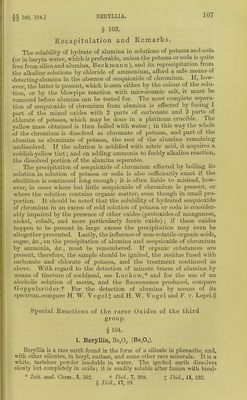
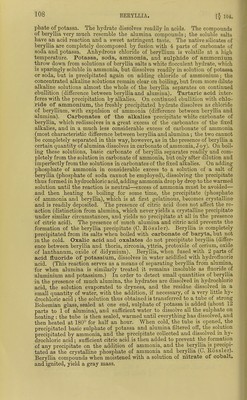
![§§ 103, 104.] § 103. Recapitulation and Remarks. The solubility of hych-ate of alumina in solutions of potassa and soda (or in baryta water, which is preferable, unless the potassa or soda is quite free from silica and alumina, Beckmann), and its reprecipitation from the alkaline solutions by chloride of ammonium, afford a safe means of detecting alumina in the absence of sesquioxide of chromium. If, how- ever, the latter is present, which is seen either by the colour of the solu- tion, or by the blowpipe reaction with microcosmic salt, it must be removed before alumina can be tested for. The most complete separa- tion of sesquioxide of cln-omium from alumina is effected by fusing 1 pai-t of the mixed oxides with 2 parts of carbonate and 2 parts of chlorate of potassa, which may be done in a platinum crucible. The yellow mass obtained is then boiled with water; in this way the whole of the chromium is dissolved as chromate of potassa, and part of the alumina as aluminate of potassa, the rest of the alumina remaining undissolved. If the solution is acidified with nitric acid, it acquii^es a reddish-yellow tint; and on adding ammonia to feebly alkaline reaction, the dissolved portion of the alumina separates. The precipitation of sesquioxide of chromium effected by boiling its solution in solution of potassa or soda is also sufiiciently exact if the ebuUition is continued long enough; it is often Hable to mislead, how- ever, in cases where but little sesquioxide of chromium is present, or where the solution contains organic matter, even though in small pro- portion. It should be noted that the solubility of hydrated sesquioxide of chromium in an excess of cold solution of potassa or soda is consider- ably impaired by the presence of other oxides (protoxides of manganese, nickel, cobalt, and more particularly ferric oxide); if these oxides happen to be present in large excess the precipitation may even be altogether prevented. Lastly, the influence of non-volatile organic acids, sugar, (fee, on the precipitation of alumina and sesquioxide of chromium by ammonia, &c., must be remembered. If organic substances are present, therefore, the sample should be ignited, the residue fused with carbonate and chlorate of potassa, and the treatment continued as above. With regard to the detection of minute traces of alumina by means of tincture of cochineal, see Luckow,* and for the use of an alcohohc solution of morin, and the fluorescence produced, compare Goppelsroder.t For the detection of alumina by means of its spectrum, compare H. W. VogelJ and H. W. Vogel and F. v. Lepel.§ Special Reactions of the rarer Oxides of the third group. § 104. 1. Beryllia, Be^O-^ [Be,0,]. BerylHa is a rare earth found in the form of a silicate in phenacite, and, with other silicates, in beryl, euclase, and some other rare minerals. It is a white, tasteless powder insoluble in water. The ignited earth dissolves slowly but completely in acids; it is readily soluble after fusion with bisul- * Zeit. anal. Chem., 3, ,S62. i Ibid., 7, 208. J Thid., 15, 332. § Ibid., 17, 89.](https://iiif.wellcomecollection.org/image/b21966953_0131.jp2/full/800%2C/0/default.jpg)