Licence: Public Domain Mark
Credit: Qualitative chemical analysis / by C. Remigius Fresenius. Source: Wellcome Collection.
Provider: This material has been provided by the Royal College of Physicians of Edinburgh. The original may be consulted at the Royal College of Physicians of Edinburgh.
164/526 page 140
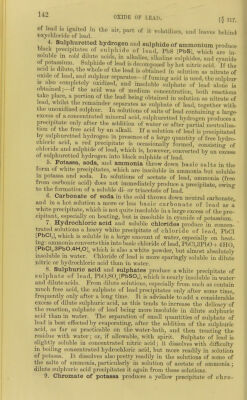
![MERCUEOUS OXIDE. [§ 116. the chloride of silver is again separated by acids. Concentrated hydro- chloric acid and concentrated solutions of chlorides of the alkali metals, dissolve chloride of silver to a very perceptible extent, more particularly on application of heat; but the dissolved chloride separates again on dilution. When strongly heated, chloride of silver fuses without decom- position, and on cooling forms a translucent horny mass. 8. If compounds of silver are mixed with carbonate of soda and exposed on a charcoal support to the inner flame of the blowpipe, white brilliant malleable metallic globules are obtained, with or without a slight dark red incrustation of the charcoal. The metal is also readily reduced in the stick of charcoal (p. 24). § 116. I. Mercurous Oxide or Suboxide of Mercury, Hg,0 [Hg,0]. 1. Metallic mercury is a grayish-white, lustrous liquid at ordi- nary temperatures; it solidifies at - 39°, and boHs at 360°. It is insoluble in hydrochloric acid; but dissolves in cold dilute nitric acid to nitrate of mercurous oxide, in concentrated hot nitric acid to nitrate of mercuric oxide. 2. Mercurous oxide is a black powder, readily soluble in nitric acid. It is decomposed by the action of heat, the mercury volatilizing in the metallic state. It forms no hydrate. _ 3. The salts^ of mercurous oxide, when ignited, volatilize usually with decomposition; mercurous chloride and bromide, however, volatihze unaltered. Most of the salts of mercurous oxide are colourless. The soluble salts in the neutral state redden litmus-paper. On addition of much water, nitrate of mercurous oxide is decom.posed into a hght yellow insoluble basic salt and a soluble acid salt. 4. Sulphuretted hydrogen and sulphide of ammonium pro- duce black precipitates, which are insoluble in dilute acids, sulphide of ammonium, and cyanide of potassium. The precipitates consist, not of mercurous sulphide, but of mercuric sulphide mixed with mer- cury. Monosulphide of sodium, in presence of some caustic soda,, dissolves this precipitate with separation of metallic mercury; bisul- phide of sodium dissolves it without separation of metaUic mercury; the solutions contain sulphide of mercury HgS [HgS]. The precipitate gives up mercury to boiling concentrated nitric acid with formation of a white double compound, namely, 2IIgS + HgO,N05 [2HgS,Hg(N03)J.. The precipitate is readily dissolved by aqua regia. 5. Potassa, soda, and ammonia produce black precipitates, which are insoluble in an excess of the precipitants. The precipitates produced by the fixed alkalies consist of mercurous oxide, whilst those pro- duced by ammonia consist of basic salts containing ammonia or amidogen. 6. Hydrochloric acid and soluble metallic chlorides precipitate mercurous chloride, Hg^Cl [HgaCI], as a fine powder of dazzHng whiteness. Cold hydrochloric acid and cold nitric acid do not dissolve this precipitate; it dissolves, however, although with great difficulty and very slowly, on long-continued boiling with these acids, being resolved](https://iiif.wellcomecollection.org/image/b21966953_0164.jp2/full/800%2C/0/default.jpg)