Licence: Public Domain Mark
Credit: Qualitative chemical analysis / by C. Remigius Fresenius. Source: Wellcome Collection.
Provider: This material has been provided by the Royal College of Physicians of Edinburgh. The original may be consulted at the Royal College of Physicians of Edinburgh.
167/526 page 143
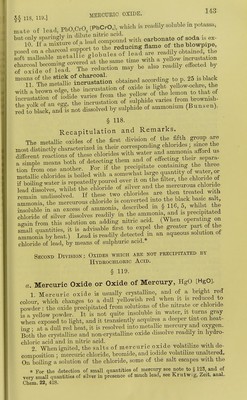
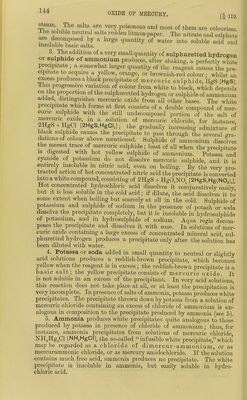
![us, 119.] MEECurac oxide. nvxte of lead, TW,GrO, [PbCrOJ, which is readily soluble in potassa, but only sparingly ,vith carbonate of soda is ex- 10. If a mixture of a ^^^^^/^''^fiP^;^'^;^^^ flame of tHe blowpipe, posed on a clmrcoa support to^^^^^^^ readily obtained, the soft malleable ?^^*^^ll^^,^^V^;,\',,e time with a yellow incrustation :nxtrt '^^'^^ means of the stick of charcoaL according to p. 25 is black 11. The nietalhc mcrustation^^^^^^^^^^ § 118. Recapitulation and Remarks. The metallic oxides of the fix;st ^^^^^ f ''^'^l^.^^ZZ leaa aissoiveb, w chlorides are then treated with rride'rof— into th^^^^'f te' insoluble in an excess of ammonia, described in § 116, 5, whilst the ride of silver dissolves -^^^^^^^^^^^^^ = ;rnt tt, tr^^^^^^^^^ greater W the^ ammonrby heat.) Lead is readily detected m an aqueous solution of chloride of lead, by means of sulphuric acid. Second Division : Oxides which are not precipitated by Hydrochloric Acid. § 119- a. Mercuric Oxide or Oxide of Mercury, HgO [HgO]. 1 Mercuric oxide is iisnaUy crystalline, and of a ^r^ht red- colour, which changes to a dull yellowish red when it is reduced to powder : the oxide precipitated from solutions of the nitrate or chloride is a yeUow powder. It is not quite insoluble m water, it turns gray when exposed to light, and it transiently acquires a deeper tint on heat- ing • at a dull red heat, it is resolved into metallic mercury and oxygen. B?th the crystalline and non-crystallme oxide dissolve readily m hydro- chloric acid and in nitric acid. _ 2 When ignited, thesaltsofmercuricoxide volatilize with de- composition ; mercuric chloride, bromide, and iodide volatilize unaltered. On boiling a solution of the chloride, some of the salt escapes with the * For the detection of small quantities of mercury see note to § 123, and of very small quantities of silver in presence of much lead, see Krutwig, Zeit. anal.. Chem. 22, 428.](https://iiif.wellcomecollection.org/image/b21966953_0167.jp2/full/800%2C/0/default.jpg)