Licence: Public Domain Mark
Credit: Qualitative chemical analysis / by C. Remigius Fresenius. Source: Wellcome Collection.
Provider: This material has been provided by the Royal College of Physicians of Edinburgh. The original may be consulted at the Royal College of Physicians of Edinburgh.
48/526 page 24
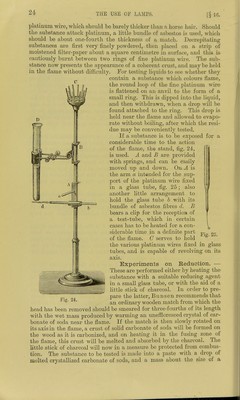
![platinum wire, which should be barely thicker than a horse hair, Should the substance attack platinum, a little bundle of asbestos is used, which should be about one-fourth the thickness of a match. Decrepitating substances are first very finely powdered, then placed on a strip of moistened filter-paper about a square centimetre in surface, and this is cautiously burnt between two rings of fine platinum wire. The sub- stance now presents the appearance of a coherent crust, and may be held in the flame without difliculty. For testing liquids to see whether they contain a substance which colours flame, the round loop of the fine platinum wire is flattened on an anvil to the form of a small ring. This is dipped into the liquid, and then withdrawn, when a drop will be found attached to the ring. This drop Is held near the flame and allowed to evapo- rate without boiling, after which the resi- due may be conveniently tested. If a substance is to be exposed for a considerable time to the action _ of the flame, the stand, fig. 24, is used. A and B are provided with springs, and can be easily moved up and down. On A is the arm a intended for the sup- port of the platinum wire &xed in a glass tube, fig. 25; also \] another little arrangement to hold the glass tube b with its bundle of asbestos fibres d. B bears a clip for the reception of a test-tube, which in certain cases has to be heated for a con- siderable time in a definite part of the flame. G serves to hold the various platinum wires flxed in glass tubes, and is capable of revolving on its axis. Experiments on Reduction. — These are performed either by heating the substance with a suitable reducing agent in a small glass tube, or with the aid of a little stick of charcoal. In order to pre- pare the latter, Bunsen recommends that ■ an ordinary wooden match from which the head has been removed should be smeared for three-fourths of its length with the wet mass produced by warming an unefiloresced crystal of car- bonate of soda near the flame. If the match is then slowly rotated on its axis in the flame, a crust of solid carbonate of soda will be formed on the wood as it is carbonized, and on heating it in the fusing zone of the flame, this crust will be melted and absorbed by the charcoal. The little stick of charcoal will now in a measure be protected from combus- tion. The substance to be tested is made into a paste with a drop of molted crystallized carbonate of soda, and a mass about the size of a](https://iiif.wellcomecollection.org/image/b21966953_0048.jp2/full/800%2C/0/default.jpg)