Licence: Public Domain Mark
Credit: Qualitative chemical analysis / by C. Remigius Fresenius. Source: Wellcome Collection.
Provider: This material has been provided by the Royal College of Physicians of Edinburgh. The original may be consulted at the Royal College of Physicians of Edinburgh.
52/526 page 28
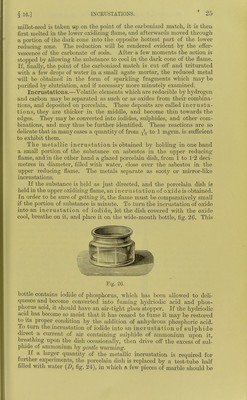
![2. A blue, a violet, a red, and a green glass. The blue glass is tinted with protoxide of cobalt; the violet glass with sesquioxide of manganese; the red glass (partly coloured, partly uncoloured) with sub- oxide of copper; and the green glass with sesquioxide of iron and prot- oxide of copper. The common coloured glass will generally be found to answer the purpose. Full information as to the tints imparted to the flame by different substances, when viewed through the aforesaid media, and the combinations by which these substances are severally identified, will be found in Section III., in the paragraphs treating of the several bases and acids. Spectrum Analysis.—The second method, which is called Spec- trum Analysis, was introduced by Kirchhoff and Bunsen. It consists in allowing the rays of the coloured flame to pass first through a narrow slit, and then through a prism, observing the refracted rays through a telescope. A distinct spectrum is thus obtained for every flame-colouring metal; this spectrum consists either, as in the case of baryta, of a number of coloured lines lying side by side; or, as in the case of lithia, of two separate, differently coloured lines; or, as in the Fig. 29 a. case of thallium, of a single green line. These spectra are character- istic in a double sense, for the spectrum lines not only have a distinct colour, but they also occupy a fixed position. It is this latter circumstance which enables us to identify every individual metal without difficulty, in the s]pectrum observations of mixtures of flame-colouring metals; for instance, a flame in which a mixture of potassa, soda, and lithia salts is evaporated, will give, side by side, the spectra of the sevei'al metals in the most perfect purity. Kirchhoff and Bunsen have constructed two kinds of apparatus, which are both of them suited for spectrum observation, and enable the operator to determine by measure the positions in which the spectrum lines make their appearance. Both are constructed on the same](https://iiif.wellcomecollection.org/image/b21966953_0052.jp2/full/800%2C/0/default.jpg)