Licence: Public Domain Mark
Credit: Qualitative chemical analysis / by C. Remigius Fresenius. Source: Wellcome Collection.
Provider: This material has been provided by the Royal College of Physicians of Edinburgh. The original may be consulted at the Royal College of Physicians of Edinburgh.
76/526 page 52
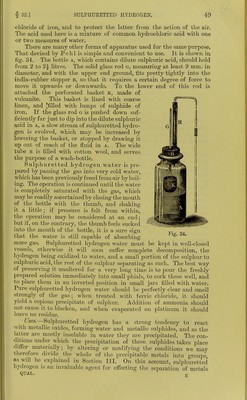
![dryness, it should leave a residue which yields a clear solution when dissolved in water. The solution acidified with hydrochloric acid, and then mixed with ammonia in the least possible excess, should not show any flocks of alumina, at least until it has stood in a warm place for several hours. The solution after being acidified with nitric acid should jiot give any precipitate with a nitric acid solution of molybdate of ammonia. c. Hydrate of potassa prepared with baryta.—Pure crystals of baryta (§36) are dissolved in hot water, and pure sulphate of potassa added to the solution until a portion of the filtered liquid, acidified with hydrochloric acid and diluted, no longer gives a precipitate on the addition of a further quantity of the sulphate (16 parts of crystals of baryta require 9 parts of sulphate of potassa). When the turbid solu- tion becomes clear, it is decanted from the sulphate of baryta, and evaporated in a silver dish as in h. The hydrate of potassa so prepared is perfectly pure, except that it contains a trifling admixture of sulphate of potassa, which is left behind on dissolving the hydrate in a little water. This hydrate is but rarely required, its use being m fact exclusively confined to the detection of minute traces of alumina. Uses. The great affinity which the fixed alkalies have for acids renders these substances powerful agents in eflfecting the decomposition of the salts of most bases, and consequently precipitates those basses which are insoluble in water. Many of the oxides thus precipitated redissolve in an excess of the precipitant, as, for instance, alumina, sesquioxide of chromium, and oxide of lead; whilst others remain undissolved, such as ferric oxide, oxide of bismuth, &c. The fixed alka- lies serve therefore to separate the former from the latter. Potassa and soda likewise dissolve many salts (such as chromate of lead), sulphur com- pounds, &c., and are useful for separating and distinguishing them troni other substances. Many of the oxides precipitated by the action ot potassa or soda exhibit peculiar colours, or possess other characteristic properties which may serve to detect the individual metals which they respectively contain ; such, for instance, are the precipitates of hydrate of protoxidB of manganese, hydrate of protoxide of iron, mercurous oxide, &c As ^ed alkalies expel ammonia from its salts, we are by this means enabled to detect that compound by its odour, its action on vegetable colours, &c. § 35. 2. Ammonia, ^3 [NH3]. Preparation.—A-yximoniii is generally prepared in cast-iron vessels on a large scale, and it will be found more economical to buy it.* For Dreparinff it on a small scale, the following method answers well. 4 parts of chloride of ammonium, either crystallized or in lumps, are introduced into a flask together with the dry hydrate of lime prepared from 5 parts of quicklime, the two mixed by shaking, and enough water is added cautiously to make the powder agglomerate into lumps. The flask is then placed on a sand bath and connected with a rather_ large wash-bottle and delivery tube. A small quantity of water is put in the wash-bottle, and about 10 parts of water m the flask destined to absorb * An exceUent method for preparing ammonia in rather large quantities will be found in Zeit. anal. Chem., 1, 186.](https://iiif.wellcomecollection.org/image/b21966953_0076.jp2/full/800%2C/0/default.jpg)