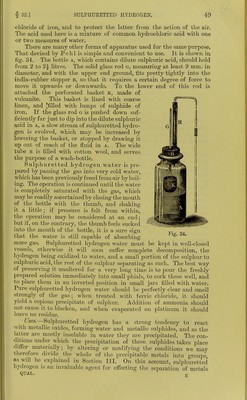
Licence: Public Domain Mark
Credit: Qualitative chemical analysis / by C. Remigius Fresenius. Source: Wellcome Collection.
Provider: This material has been provided by the Royal College of Physicians of Edinburgh. The original may be consulted at the Royal College of Physicians of Edinburgh.
77/526 page 53
![63 tlie gas; the latter being placed in cold water. On applying heat, the evolution of gas begins; the heating is continued until no more bubbles appear, when the cork of the flask must be taken out to prevent the liquid from receding. The solution of ammonia contained in the wash- ing bottle is impure, but that contained in the receiver is quite pure. It'^should be diluted with water until the sp. gr. is about 0*96 -= 10 per cent, of ammonia, and kept in bottles closed with ground stoppers. Tests.—Solution of ammonia should be colourless, and ought not to leave the least residue on evaporation in a platinum dish. When heated with an equal volume of lime water, it should cause no turbidity, at least not to a marked extent (carbonic acid). After supersaturation with nitric acid, no turbidity should be produced either by solution of nitrate of baryta or by nitrate of silver, and sulphuretted hydrogen should not impart to it the slightest colour. On neutralizing the am- monia with dilute hydrochloric acid, it should remain colourless, and should not emit any empyreumatic odour. ITses.—Solution of ammonia, liquor ammon., is really only a solution of ammonia in water, but it is sometimes convenient to consider it as a solution of oxide of ammonium, NH3 + H0 = NHp [2NH3 + H,0 = (NH,),0]. On this assumption, solution of ammonia may be regarded as analogous to soliition of potassa or soda; this greatly simplifies the explanation of all its reactions, the oxygen salts resulting from the neutralization of oxygen acids by solution of ammonia being also assumed to contain oxide of ammonium ISTH^O, instead of ammonia, NHg. Ammonia is one of the most frequently used reagents. It is especially useful for saturating acid hquids, and also for the precipitation of a great many metallic oxides and earths; many of these precipitates redissolve in excess of ammonia, as, for instance, the oxides of zinc, cadmium, silver, copper, (fee, whilst others are insoluble in free ammonia. This reagent serves therefore to separate and distinguish the former from the latter. As some of these precipitates, as well as their solutions in ammonia, exhibit peculiar colours, they at once serve to detect the metals which they respectively contain. Many of the oxides which are precipitated by ammonia from neutral solutions are not precipitated by this reagent from acid solutions, their precipitation fio;a the latter being prevented by the ammonia salt formed in the process. Compare § 53. ^. Alkaline Earths. §36. 1. Hydrate of Baryta, BaO,HO [BaHAj. Pre]xiration.—There are a great many ways of preparing hydrate of 1;aryta; but as witherite is easily and cheaply procurable, the following method is preferable to all others: 100 parts of finely pulverized witherite are intimately mixed with 10 parts of powdered charcoal and parts of resin, the mixture is introduced into an earthenware pot, the lid is luted on with clay, and the vessel is then heated in a tile-kiln. The baked mass is powdered, boiled repeatedly with water in an iron pot, and filtered into flasks which are closed and allowed to remain](https://iiif.wellcomecollection.org/image/b21966953_0077.jp2/full/800%2C/0/default.jpg)