The three kinds of cod liver oil : comparatively considered with reference to their chemical and therapeutic properties / by L.J. de Jongh ; translated from the German, with an appendix and cases, by Edward Carey.
- Date:
- 1849
Licence: Public Domain Mark
Credit: The three kinds of cod liver oil : comparatively considered with reference to their chemical and therapeutic properties / by L.J. de Jongh ; translated from the German, with an appendix and cases, by Edward Carey. Source: Wellcome Collection.
Provider: This material has been provided by the Royal College of Physicians of Edinburgh. The original may be consulted at the Royal College of Physicians of Edinburgh.
29/210 page 11
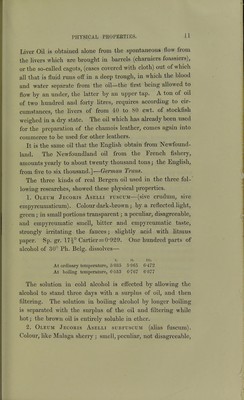
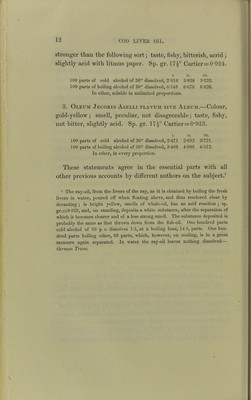
![PHYSICAL PROPERTIES. Liver Oil is obtained alone from the spontaneous flow from the livers which are brought in barrels (charniers foassiers), or the so-called cagots, (cases covered with cloth) out of which all that is fluid runs off in a deep trough, in which the blood and water separate from the oil—the first being allowed to flow by an under, the latter by an upper tap. A ton of oil of two hundred and forty litres, requires according to cir- cumstances, the livers of from 40 to 80 cwt. of stockfish weighed in a dry state. The oil which has already been used for the preparation of the chamois leather, comes again into commerce to be used for other leathers. It is the same oil that the Enghsh obtain from Newfound- land. The Newfoundland oil from the French fishery, amounts yearly to about twenty thousand tons; the English, from five to six thousand.]—German Trans. The three kinds of real Bergen oil used in the three fol- lowing researches, showed these physical properties. 1. Oleum Jecoris Aselli fuscum—(sive crudum_, sive empyreumaticum). Colour dark-brown; by a reflected light, green; in small portions transparent; a pecuhar, disagreeable, and empyreumatic smell, bitter and empyreumatic taste, strongly irritating the fauces; slightly acid with litmus paper. Sp. gr. 17^° Cartier=0-929. One hundred parts of alcohol of 30° Ph. Belg. dissolves— I. n. III. At ordinary temperatui'e, 6-885 5-965 6-472 At boiling temperature, 6-553 6-767 6 877 The solution in cold alcohol is effected by allowing the alcohol to stand three days with a surplus of oil, and then filtering. The solution in boiling alcohol by longer boiling is separated with the surplus of the oil and filtering while hot; the brown oil is entirely soluble in ether. 2. Oleum Jecoris Aselli subfuscum (alias fuscum). Colour, like Malaga sherry ; smell, peculiar, not disagreeable.](https://iiif.wellcomecollection.org/image/b21982892_0029.jp2/full/800%2C/0/default.jpg)
 No text description is available for this image
 No text description is available for this image
 No text description is available for this image