Volume 1
Practical agriculture; or, a complete system of modern husbandry : with the methods of planting, and the management of live stock / By R.W. Dickson.
- Dickson, R. W.
- Date:
- 1805
Licence: Public Domain Mark
Credit: Practical agriculture; or, a complete system of modern husbandry : with the methods of planting, and the management of live stock / By R.W. Dickson. Source: Wellcome Collection.
129/882
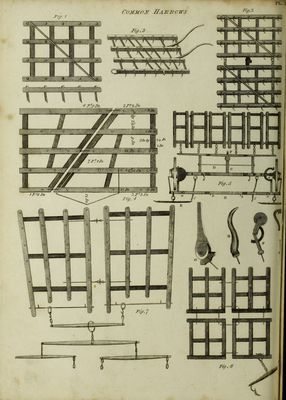
![Coynmon Harrows, [To face Page 40.] Improved Common Harrows are much employed in many dlftricls. Fig. I. Is a Common Harrow, frequently made ufe of in firfl reducing the uneven furface left by the plough. Fig. 2. A Double Harrow of the fame kind. Fig. 3. A Jointed Brake Harro%v; to which are handles fixed behind for the purpofeof raifing it occafionally, when it may be neceflary to clear it from roots, &c. Fig. 4. Is an Improved Harrow made ufe of by Mr. Grayburn in Lincolnfhire. From its being connecled by hinges in the middle, it may be employed with great advantage where the ridges are much raifed. It is recommended in the Agricultural Survey of that diftridf. Fig. 5. A Wheel-Harronu invented by Mr. Knight, by wliich the llrefs on the horfes is rendered lefs, and the harrow not fo liable to choke up. It is conftrufted with two joints, A A, in the axle tree, one of which is covered, as when the harrows are at work ; the other un- covered, to ftiow the conftrufUon of the joint; and two joints, a a, in the front of the bar, by means of which the pliability of the tree, and that of the bar, humour the wheels, and keeps them in their proper diredlions in the furroW;; and, requiring very little fcope of ground, the turnings are rendered convenient and eafy. If in working the land the breadth of the furrows is varied, it is contrived, in order to make the harrow narrower, that that part of the bar B, which is faltened by two pins ^ i’, maybe taken off when requifite ; part of the axle-tree, and part of the hind-bar C, both which are faftened by the iron bolt D, are alfo to be removed ; and the remaining outward parts to be joined and faftened by one of the two pins in the bar, and by a fliorter bolt d, (hown feparate, and intended for the axle-tree and hind- bar. And when two horfes which are unequal in height are wrought, as the horizontal direc- tion, or evennefs of the joints, may be deftroyed in fome degree; to remedy and fupply the deficiency in the horfes, the whipple-tree E is made to be heightened or lowered by means of notches e, fliown feparate, to which it is conne£led by a ring. In light barley-lands, to ac- commodate the harrow for one horfe, by narrowing it as dire£ted above, there are two firings conveyed by two rings from the axle-tree, through two loops, /f, under the front bar. The wheel F, under the hind-bar, w’hich is Ihown enlarged and feparate in the plate, will fupport the bar; and by this aftiftance the harrow is conveyed to the field on the axle-tree bar, as a fubftitute for a fledge: there are alfo two wooden pegs, g g, by which the harrows, when turned upon the carriage, are fecured. To lelTen the expenfe of iron in this harrow, an axle- tree and joints may be readily conftrucled in wood, upon the fame principle as fliowni in the plate feparate at G ; though preference Ihould be given to iron. If the wheel under the hind- bars be not adopted, there is a Aider H, fhowm feparate, which works with a pin, and, when not wanted, is turned and faftened under the axle-tree. As it is often found ufeful to heighten or lower the harrow occafionally, particularly on broad lands rifing in the middle; where of courfe the middle harrow takes mod hold, and generally requires the leaft ; this may be eafily effefted, by fixing irons, with notches, like thofe on the fore-bar, by which the whipple-trees are fupported, on the hind-bar, inftead of the hooks, and putting the hooks on thofe irons. At Fig. 6. A Four-fqtiare Harrow, employed on new-inclofed and broken-up lands in the midland diftrifls, where the ground is very uneven. Fig. 7. An Improved Harrow, with running bulls ; By this contrivance the harrows are pre- vented from riding on each other, or turning over at the ends of the ridges in returning. They are made by Mr. Hanford, and found to anfwer w'ell in Leicefterfliire. The price about 3I. 3s.](https://iiif.wellcomecollection.org/image/b22006904_0001_0129.jp2/full/800%2C/0/default.jpg)
 No text description is available for this image
 No text description is available for this image
 No text description is available for this image