On the physiological action of carbon monoxide of nickel / John G. McKendrick and William Snodgrass.
- McKendrick, John G. (John Gray), 1841-1926.
- Date:
- [1891]
Licence: Public Domain Mark
Credit: On the physiological action of carbon monoxide of nickel / John G. McKendrick and William Snodgrass. Source: Wellcome Collection.
Provider: This material has been provided by The University of Glasgow Library. The original may be consulted at The University of Glasgow Library.
3/18
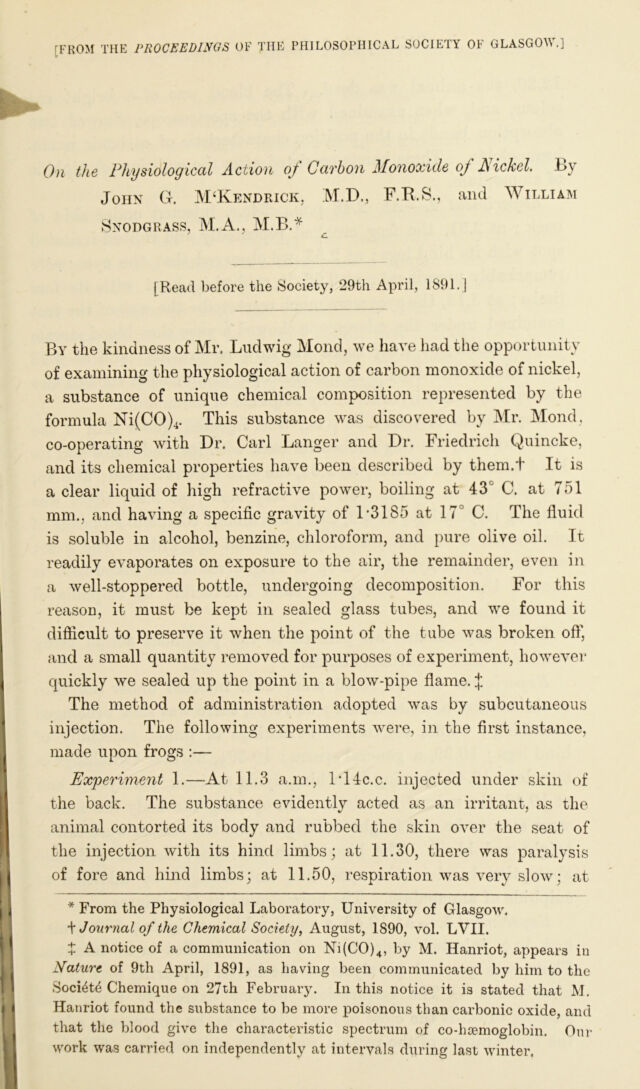
![[FROM THE PROCEEDINGS OF THE PHILOSOPHICAL SOCIETY OF GLASGOW.] On the Physiological Action oj Carhoyi Monoxide of liickel. t>y John G. APKendrick, M.D., F.K.S., aiul William Snodgrass, M.A., M.B.* [Read before the Society, 29th April, 1891.] By the kindness of Mr. Ludwig Mond, we have had the opportunity of examining the physiological action of carbon monoxide of nickel, a substance of unique chemical composition represented by the formula Ni(CO)4. This substance was discovered by ]\[r. Mond, co-operating with Dr. Carl Danger and Dr. Friedrich Quincke, and its chemical properties have been described by them.f It is a clear liquid of high refractive power, boiling at 43° C. at 751 mm., and having a specific gravity of 1*3185 at 17° C. The fluid is soluble in alcohol, benzine, chloroform, and pure olive oil. It readily evaporates on exposure to the air, the remainder, even in a well-stoppered bottle, undergoing decomposition. For this reason, it must be kept in sealed glass tubes, and we found it difficult to preserve it when the point of the tube was broken off, and a small quantity removed for purposes of experiment, however quickly we sealed up the point in a blow-pipe flame. J The method of administration adopted was by subcutaneous injection. The following experiments were, in the first instance, made upon frogs :— Ex'periment 1.—At 11.3 a.m., l*14c.c. injected under skin of the back. The substance evidently acted as an irritant, as the animal contorted its body and rubbed the skin over the seat of the injection Avith its hind limbs; at 11.30, there was paralysis of fore and hind limbs; at 11.50, respiration was very slow; at * From the Physiological Laboratory, University of Glasgow. \ Journal of the Chemical Society, August, 1890, vol. LVII. t A notice of a communication on Ni(C0)4, by M. Hanriot, appears in Nature of 9th April, 1891, as having been communicated by him to the Soci^td Chemique on 27th February. In this notice it is stated that M, Hanriot found the substance to be more poisonous than carbonic oxide, and that the blood give the characteristic spectrum of co-hsemoglobin. Oui- work was carried on independently at intervals during last winter.](https://iiif.wellcomecollection.org/image/b24930155_0005.jp2/full/800%2C/0/default.jpg)