Annual report / Department of Public Health, Research Institute and Endemic Diseases Hospital.
- Egypt. Maṣlaḥat al-Ṣiḥḥah al-ʻUmūmīyah. Research Institute and Endemic Diseases Hospital.
- Date:
- [1934]
Licence: Public Domain Mark
Credit: Annual report / Department of Public Health, Research Institute and Endemic Diseases Hospital. Source: Wellcome Collection.
34/180 (page 20)
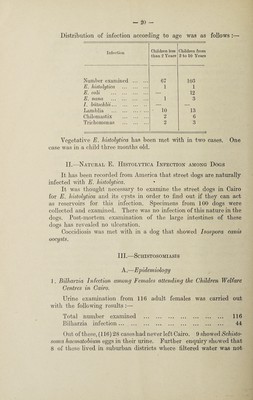
![Distribution of infection according to age was as follows :— Infection Children less than 2 Years Children from 2 to 10 Years Number examined . 67 103 E. histolytica . 1 1 E. coli . — 12 E. nana . 1 3 I. biltschlii. — — Lamblia .A ... 10 13 Chilomastix . 2 6 Trichomonas . 2 3 Vegetative E. histolytica has been met with in two cases. One case was in a child three months old. II.—Natural E. Histolytica Infection among Dogs It has been recorded from America that street dogs are naturally infected with E. histolytica. It was thought necessary to examine the street dogs in Cairo for E. histolytica and its cysts in order to find out if they can act as reservoirs for this infection. Specimens from 100 dogs were collected and examined. There was no infection of this nature in the dogs. Post-mortem examination of the large intestines of these dogs has revealed no ulceration. Coccidiosis was met with in a dog that showed Isospora canis oocysts. III.—Schistosomiasis A.—Epidemiology ]. Bilharzia Infection among Females attending the Children Welfare Centres in Cairo. Urine examination. from 116 adult females was carried out with the following results :— Total number examined . 116 Bilharzia infection. 44 Out of these, (116) 28 cases had never left Cairo. 9 showed Schisto¬ soma haematobium eggs in their urine. Further enquiry showed that 8 of these lived in suburban districts where filtered water was not](https://iiif.wellcomecollection.org/image/b31497378_0034.jp2/full/800%2C/0/default.jpg)