The fyrst boke of the introduction of knowledge made by Andrew Borde, of physycke doctor : A compendyous regyment; or, A dyetary of helth made in Mountpyllier / compyled by Andrewe Boorde, of physycke doctour. Barnes in the defence of the berde: a treatyse made, answerynge the treatyse of Doctor Borde upon berdes / edited, with a life of Andrew Boorde, and large extracts from his Brevyary, by F.J. Furnivall.
- Andrew Boorde
- Date:
- 1870
Licence: Public Domain Mark
Credit: The fyrst boke of the introduction of knowledge made by Andrew Borde, of physycke doctor : A compendyous regyment; or, A dyetary of helth made in Mountpyllier / compyled by Andrewe Boorde, of physycke doctour. Barnes in the defence of the berde: a treatyse made, answerynge the treatyse of Doctor Borde upon berdes / edited, with a life of Andrew Boorde, and large extracts from his Brevyary, by F.J. Furnivall. Source: Wellcome Collection.
Provider: This material has been provided by The University of Leeds Library. The original may be consulted at The University of Leeds Library.
31/406 page 25
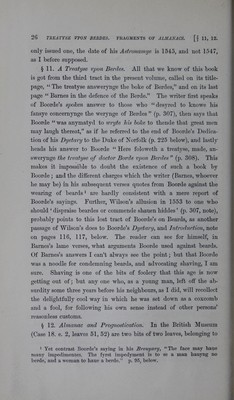
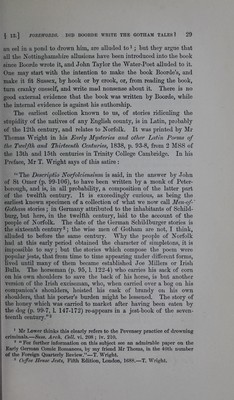
![§ 10.] FOREWORDS. BOORDE’s PRONOSTYCACYON FOR 1545 A.D. which that blind old noodle Time is to blame,—as we may he sure that the Sermons of a man like Boorde would have pictured his time for us better than almost any book we have. § 10. A Pronostycacyon for the yere 1545. Among Bagford’s collection of Almanack-titles in the Harleian MS 5937, I have been lucky enough to notice the title-page of a hitherto uncatalogued work of Andrew Boorde’s, which is, I suppose, unique : “A Pronosty-/cacyon or an Almanacke for / the yere of our lorde .M. CCCCC. / xlv. made by Andrewe Boorde / of Physycke doctor an En-/glyshe man of the vni-/versite of Ox-/forde,” Over a rose-shaped cut with a castle in the centre, used in the titleless edition of the Shepherd’s Calendar in the British Museum, formerly entered as (?) Pynson’s, but which, I am persuaded, is W. Coplande’s. On the back is “ The Prologe to the reder. IWere nat wyse, but inscipient, if I shulde enterpryse to wryte or to make any boke of p?,ophes}'re, or els to pronostycate any mater of the occulte iugement of god, or to defyne or determyne any supernatural mater aboue reson, or to presume to medle with the bountyfull goodnes of god, who doth dispose euery thing graciously. All such occulte and secrete maters, for any man to medle with-all, it is prohibited both by goddes lawe & the lawe of kynge Henry the eyght1. But for as muche as the excellent scyence of Astronomy is amytted dayly to be studyed & exercysed in al vniuersities, & so approued to be ye chiefe science amonge all the other lyberal sciences, lyke to the son, the which is in the medle of the other planetes illumynatynge as wel the inferyal planetes as ye superyal planetes, So in lyke maner Astronomy doth illucydat all the other lyberal sciences, indusing them to celestyall & terrestyall knowlege. D[o]the nat the planetes, sygnes, and other st[ers ijnduce vs to the knowlege of a c[reator of] tlie?n, doth nat ye Mone gyue moyster to the 2 ” Coupling this with the fact already noticed, p. 16,1. 16, above, that Boorde in his Astronamye refers to Robert Coplande who prints ‘ thes yere my pronostycayons,’ we must either conclude (as I do myself) that Boorde, like the Laets of Antwerp—grandfather, father, and son3—issued Prognostications yearly for some time, or that, if he 1 Stat. 33, Hen. VIII, cap. 8, A.D. 1541-2. See Queene Elizabethes Acha- demy, notes. * ‘ to the ’ are the catchwords. See my Captain Cox, or Laneham's Letter, for the Ballad Society, 1870.](https://iiif.wellcomecollection.org/image/b21529589_0031.jp2/full/800%2C/0/default.jpg)




 No text description is available for this image
 No text description is available for this image
 No text description is available for this image