The fyrst boke of the introduction of knowledge made by Andrew Borde, of physycke doctor : A compendyous regyment; or, A dyetary of helth made in Mountpyllier / compyled by Andrewe Boorde, of physycke doctour. Barnes in the defence of the berde: a treatyse made, answerynge the treatyse of Doctor Borde upon berdes / edited, with a life of Andrew Boorde, and large extracts from his Brevyary, by F.J. Furnivall.
- Andrew Boorde
- Date:
- 1870
Licence: Public Domain Mark
Credit: The fyrst boke of the introduction of knowledge made by Andrew Borde, of physycke doctor : A compendyous regyment; or, A dyetary of helth made in Mountpyllier / compyled by Andrewe Boorde, of physycke doctour. Barnes in the defence of the berde: a treatyse made, answerynge the treatyse of Doctor Borde upon berdes / edited, with a life of Andrew Boorde, and large extracts from his Brevyary, by F.J. Furnivall. Source: Wellcome Collection.
Provider: This material has been provided by The University of Leeds Library. The original may be consulted at The University of Leeds Library.
39/406 page 33
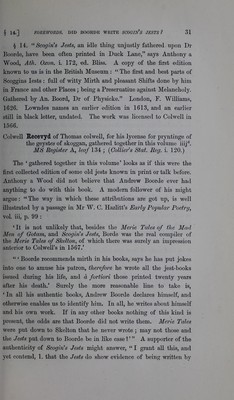
![“ A right 'pleasant and merry History of the Mylner of Ahington, with his Wife, and his fair Daughter, and of two poor Scholars of Cam- bridge. Pr. at Lond. by Bich. Jones in qu[arto]. And. Borde’s name is not to it, but the copy of the book which I saw did belong to Tho. Newton of Cheshire, [Bodl. 4to. C. 39. Art. Seld.] whom I shall hereafter mention, and by him ’tis written in the title that Dr. Borde was the author. He hath also written a Book of Prognosticks, another Of Urines, and a third Of every Region, Country and Pro- vince, which shews the Miles, Leeges, distance from City to City, and from Town to Town, with the noted Things in the said Cities and Towns.”'—Wood’s Athen. Oxon. i. 172. This tale of The Mylner of Abyngton has been reprinted lately by Mr Thomas Wright in his Anecdota Liter aria, p. 105-116, and by Mr Hazlitt in his Early Popular Poetry, iii. 100-118. It is a story like Chaucer’s Reeves Tale2, about the swiving of the Miller’s wife and daughter by two Cambridge students, in revenge for his stealing their flour, and letting their horse loose. If any one will read Andrew Boorde’s poetry, that is, doggrel, in his Introduction of Knowledge, and then turn to the Mylner, he will not need any further evidence to convince him that Boorde did not write the latter Tale. § 16. Other Works. The authority on which Wood assigns to Boorde his Books of Prognosticks and Urines, is doubtless that on which Warton (iii. 77, ed. 1840) also assigns to him the Promptuarie of Medicine and the Doctrine of Urines, namely, Bishop Bale, who in the 2nd edition of his Scriptores says : “ Andreas Boorde, ex Carthusianse superstitionis monacho, malus medicus factus, in monte Pessulano in Gallijs eius artis professionem ac doctoratum, spreto diuini uerbi ministerio, suscepit. Congessit mcechus in sacerdotalis matrimonij contemptum. Prognostica quae- dam, Lib. 1. Promptuarium Physices, Lib. 1. De iudicijs urinarum, Lib. 1. Et alia.” Neither of the other books do I know by Bale’s titles, though I suppose the Promptuarium to be Boorde’s Breuyary. Of one of the Prognostica a leaf is printed above, § 10, p. 25. I should doubt Boorde’s having written a separate treatise on Urine, as he has given more than six leaves to it in his Extrauagantes, Fol. xx-xxvi back, j and had but a bad opinion of it: 1 See above, p. 23-24. 2 Not Milleres Tale, Mr Hazlitt. BOORDE. 3](https://iiif.wellcomecollection.org/image/b21529589_0039.jp2/full/800%2C/0/default.jpg)


 No text description is available for this image
 No text description is available for this image
 No text description is available for this image