The relation between natural and synthetical glycerylphosphoric acids. [Pt. I] / by Frederick B. Power and Frank Tutin.
- Frederick Belding Power
- Date:
- [1905]
Licence: Attribution 4.0 International (CC BY 4.0)
Credit: The relation between natural and synthetical glycerylphosphoric acids. [Pt. I] / by Frederick B. Power and Frank Tutin. Source: Wellcome Collection.
Provider: This material has been provided by The Royal College of Surgeons of England. The original may be consulted at The Royal College of Surgeons of England.
4/14 page 250
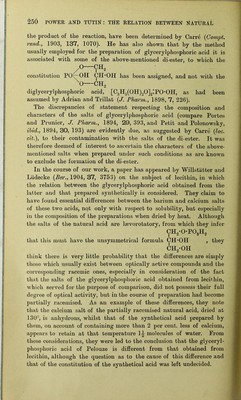
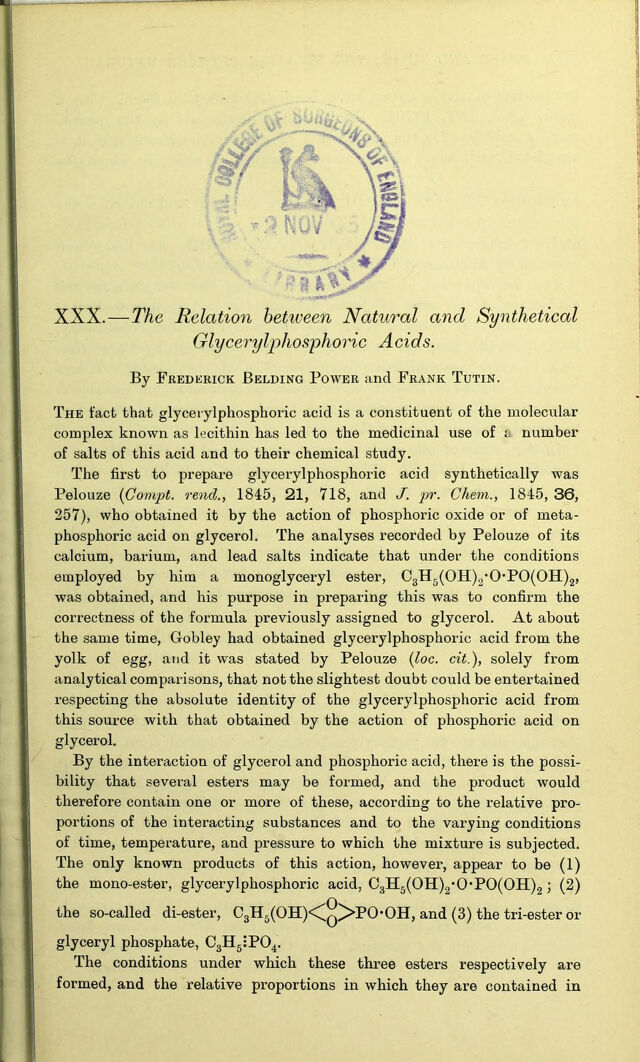
![the product of the reaction, have been determined by Carre {Comjit. rend., 1903, 137, 1070). He has also shown that by the method usually employed for the preparation of glycerylphosphoric acid it is associated with some of the above-mentioned di-ester, to which the .0—CH^ constitution PO^OH CH-OH has been assigned, and not with the ^0 CH„ diglyceryl phosphoric acid, [C3H5(0H)20]2iP0*0H, as had been assumed by Adrian and Trillat {J. Pharm., 1898, 7, 226). The discrepancies of statement respecting the composition and character’s of the salts of glycerylphosphoric acid (compare Portes and Prunier, J. Pharm., 1894, 29, 393, and Petit and Polonowsky, ibid,, 1894, 30, 193) are evidently due, as suggested by Carre {loc. cit.), to their contamination with the salts of the di-ester. It was therefore deemed of interest to ascertain the characters of the above- mentioned salts when prepared under such conditions as are known to exclude the formation of the di-ester. In the course of our work, a paper has appeared by Willstatter and Ludecke {Ber., 1904, 37, 3753) on the subject of lecithin, in which the relation between the glycerylphosphoric acid obtained from the latter and that prepared synthetically is considered. They claim to have found essential differences between the barium and calcium salts of these two acids, not only with respect to solubility, but especially in the composition of the preparations when dried by heat. Although the salts of the natui’al acid are Ijevorotatory, from which they infer CH2-0-P03H2 that this must have the unsymmetrical formula CH’OH , they CH2*0H think there is very little probability that the differences are simply those which usually exist between optically active compounds and the corresponding racemic ones, especially in consideration of the fact that the salts of the glycerylphosphoric acid obtained from lecithin, which served for the purpose of comparison, did not possess their full degree of optical activity, but in the course of preparation had become partially racemised. As an example of these differences, they note that the calcium salt of the partially racemised natural acid, dried at 130°, is anhydrous, whilst that of the synthetical acid prepared by them, on account of containing more than 2 per cent, less of calcium, appears to retain at that temperature molecules of water. From these considerations, they were led to the conclusion that the glyceryl- phosphoric acid of Pelouze is different from that obtained from lecithin, although the question as to the cause of this difference and that of the constitution of the synthetical acid was left undecided.](https://iiif.wellcomecollection.org/image/b22401970_0006.jp2/full/800%2C/0/default.jpg)