The rise, fall and revival of dental prosthesis / by B.J. Cigrand.
- Bernard J. Cigrand
- Date:
- 1893
Licence: Public Domain Mark
Credit: The rise, fall and revival of dental prosthesis / by B.J. Cigrand. Source: Wellcome Collection.
70/332 page 68
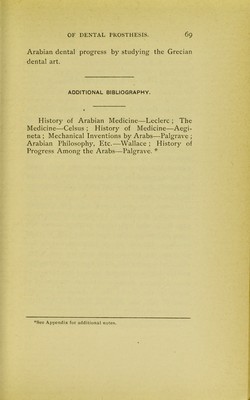
![explorer adds that “No female was entitled to marked consideration, or be known as a belle, without this peculiarity of the dental organs.”* Rhazes, and also Ebu Sina, both Arabian medi- cal men, made use of white arsenic to devitalize the pulps of badly decayed teeth. The only aim seems to have been to produce a painless decay of the tooth. The great'historian, Wuestenfeld, tells us that upwards of three hundred Arabian physicians have left voluminous writings in Arabic, and not more than four works of this number have been trans- lated, and these few exist in the Latin only, t Thus the great remainder, still in the form of Arabic manuscript, can lend us no aid in determining the exact status of the medical profession. “But it is improbable,” says Dr. J. F. Payne, “that further research will alter the general estimate of the value of Arabian medicine. There can be no doubt that it was in the main Grecian medicine modified to suit the climates, habits and national tastes, and with some important additions from oriental sour- ces. The Grecian part is taken from Hippocrates, Galen, Discorides and later Greek writers.”.']; This being the case we can indirectly get a fair idea of *Dental Cosmos, vol. X., p. 346. ► Youth’s Dentist—Duval, p. 41. fHistory of Medicine—Payne. tEncj’clopaedia Britannica, vol. XV., p. 806.](https://iiif.wellcomecollection.org/image/b2486741x_0070.jp2/full/800%2C/0/default.jpg)
 No text description is available for this image
 No text description is available for this image
 No text description is available for this image