The rise, fall and revival of dental prosthesis / by B.J. Cigrand.
- Bernard J. Cigrand
- Date:
- 1893
Licence: Public Domain Mark
Credit: The rise, fall and revival of dental prosthesis / by B.J. Cigrand. Source: Wellcome Collection.
81/332 page 79
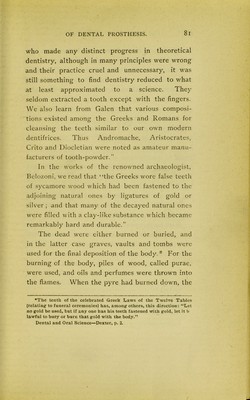
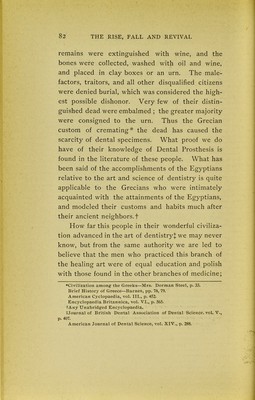
![a pair of leaden forceps in the Temple of Delphi. The leaden instrument bore the Greek name “Odontagogos,”* meaning “tooth-extractor.” Upon the death of this great surgeon, and also on the destruction of the Alexandrian library, the medical art retrograded, and to this day Greece has not recovered from the shock. The Greek writer, Cicero, gives credit to the third son of yEsculapius + for the invention of an instrument for the extraction of diseased teeth. It is further claimed that these ancients were ac- quainted with the art of healing dental caries by plugging the cavity with gold foil, and that the British museum contains skulls taken from Greek tombs, and the teeth of these aged remains are unmistakably filled with gold foil. In a museum at Athens, in an upper jaw of an ancient cranium, a tooth filled with pure gold foil]: can be seen. The skull was found in one of the tombs which date from the days of ancient Greece. From this it will appear that these ancient people, too, were familiar with gold work. Dr. Xavier Landerer, of Athens, sends the ♦Dental Cosmos, vol. VIII., p. 670. Works of C. Aurelins—Medicine. Dental and Oral Science—Dexter, p. 2. IDental Cosmos, vol. XXIII., p. 670. Vierteljahrsschrift des Vereins deutcher Zahnkueustler, 1881. tDental Cosmos, vol. XXIII., pp. 109, 110. Dental Cosmos, vol. VIII., p. 607. British Journal of Dental Science, March, 1867.' Some Remarks On the Prevalence of Dental Caries Among th» Ancients—James Bate, 1867 i](https://iiif.wellcomecollection.org/image/b2486741x_0081.jp2/full/800%2C/0/default.jpg)
 No text description is available for this image
 No text description is available for this image
 No text description is available for this image