The Russian Carboniferous and Permian compared with those of India and America : a review and discussion / by Charles Schuchert.
- Charles Schuchert
- Date:
- 1906
Licence: In copyright
Credit: The Russian Carboniferous and Permian compared with those of India and America : a review and discussion / by Charles Schuchert. Source: Wellcome Collection.
Provider: This material has been provided by The Royal College of Surgeons of England. The original may be consulted at The Royal College of Surgeons of England.
18/38 page 44
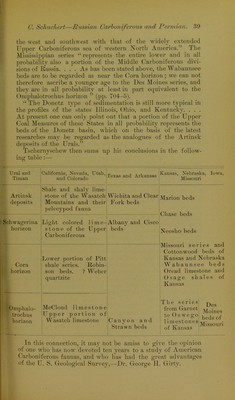
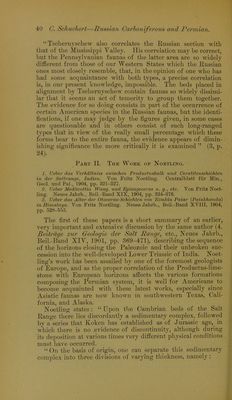
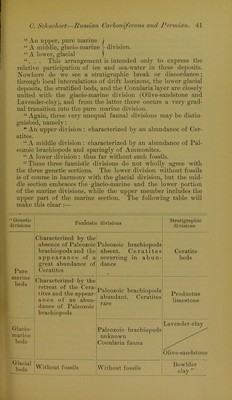
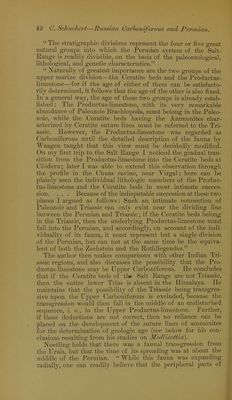
![not discussed, these being left to Prof. James Perrin Smith. In regard to the stratigraphic and evolutional conclusions attained by the author, he states: “ The views here presented are proved partly by ontogenetic, partly by phylogenetic examinations and observations, and there- fore tlieV may to a certain extent be depended upon. I must, however, note the assumption on my part that the Sicilian Fusulina-limestone is older than the Artinsk [=Permo-Carb. of the Russians] horizon, and again that the latter is older than the Productus-limestone of the Salt Range. By follow- ing out this assumption and comparing the various suture lines with one another, I obtained positive results which were proved by the development of the suture lines of M. orbignyana. This especially applies to the divisions of the external saddles ” (p. 354). “ In this connection I would [first] like to point to an observa- tion, which in spite of its scantiness permits of wholly unsur- mised deductions regarding the climatic conditions at the close of Paleozoic and the beginning of Mesozoic time. In an earlier work I had the opportunity of propounding the question—Is the abundant appearance of Produotus possibly connected with a cooler temperature of the sea-water?” [In Neues Jalir- bucli, 1896, II, p. 86, this problem is stated as follows: “ In India at least, but more particularly in the Salt Range, there was a glacial period at the beginning of Permian time. It would be interesting to examine the evidence to see if the great abundance of Produotus has any connection with the cooler temperature of the sea-water.”] “ A greater knowledge of the Paleozoic deposits of the Salt Range has given undoubted evidence of the existence of a Glacial Period at the beginning of Permian time, which deposits locally were laid down in the sea. [For a full bib- liography and a good description of the late Paleozoic glaciation of India, see .Noetling, Neues Jalirb., 1896, II, pp. 61-86.] In other words, this sea must have been one with a low temperature. Subsequently, in this sea was deposited the Productus-limestone, and the conclusion is not probable that the temperature of the water rose during the melting of the glaciers and the introduction of the Productu8-i&\vn&. In the Salt Range, therefore, this fauna is to be regarded as an arctic one. “ The studies of Medlicottia have shown that M. primas Waag. is in all probability to be regarded as a descendant of M. orbignyanus Yern. sp. of the Artinsk horizon. One can picture to himself the condition whereby the Medlicottias migrated from north to south (more correctly from northwest to southeast) at the same time that they passed into higher beds.](https://iiif.wellcomecollection.org/image/b22407194_0020.jp2/full/800%2C/0/default.jpg)