The Russian Carboniferous and Permian compared with those of India and America : a review and discussion / by Charles Schuchert.
- Charles Schuchert
- Date:
- 1906
Licence: In copyright
Credit: The Russian Carboniferous and Permian compared with those of India and America : a review and discussion / by Charles Schuchert. Source: Wellcome Collection.
Provider: This material has been provided by The Royal College of Surgeons of England. The original may be consulted at The Royal College of Surgeons of England.
20/38 page 46
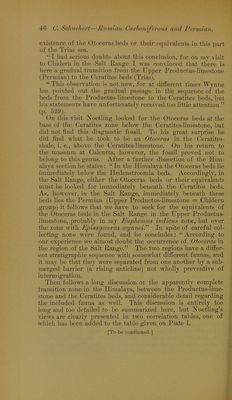
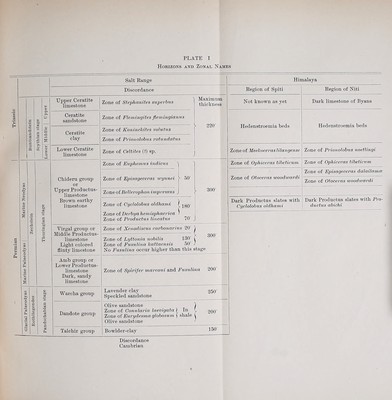
![existence of the Otoceras beds or their equivalents in this part of the Trias sea. “ I had serious doubts about this conclusion, for on my visit to Chideru in the Salt Range I was convinced that there is here a gradual transition from the Upper Productus-limestone (Permian) to the Ceratites beds (Trias). “ This observation is not new, for at different times Wynne has pointed out the gradual passage in the sequence of the beds from the Productus-limestone to the Ceratites beds, but his statements have unfortunately received too little attention ” (p. 529). On this visit Noetling looked for the Otoceras beds at the base of the Ceratites zone below the Ceratites-limestone, but did not find this diagnostic fossil. To his great surprise he did find what he took to be an Otoceras in the Ceratites- sliale, i. e., above the Ceratites-limestone. On his return to the museum at Calcutta, however, the fossil proved not to belong to this genus. After a further dissection of the Him- alaya section he states: “ In the Himalaya the Otoceras beds lie immediately below the Iledenstroemia beds. Accordingly, in the Salt Range, either the Otoceras beds or their equivalents must be looked for immediately beneath the Ceratites beds. As, however, in the Salt Range, immediately beneath these beds lies the Permian (Upper Productus-limestone = Chideru group) it follows that we have to seek for the equivalents of the Otoceras beds in the Salt Range in the Upper Productus- limestone, probably in my Euphemus indicus zone, but over the zone with Episageceras wynnei.” In spite of careful col- lecting none were found, and he concludes: “ According to our experience we almost doubt the occurrence of Otoceras in the region of the Salt Range.” The two regions have a differ- ent stratigraphic sequence with somewhat different faimas, and it may be that they were separated from one another by a sub- merged barrier (a rising anticline) not wholly preventive of intermigration. Then follows a long discussion oi the apparently complete transition zone in the Himalaya, between the Productus-lime- stone and the Ceratites beds, and considerable detail regarding the included fauna as well. This discussion is entirely too long and too detailed to be summarized here, but Hoetling’s views are clearly presented in two correlation tables, one of which has been added to the table given on Plate I. [To be continued.]](https://iiif.wellcomecollection.org/image/b22407194_0022.jp2/full/800%2C/0/default.jpg)