The Russian Carboniferous and Permian compared with those of India and America : a review and discussion / by Charles Schuchert.
- Charles Schuchert
- Date:
- 1906
Licence: In copyright
Credit: The Russian Carboniferous and Permian compared with those of India and America : a review and discussion / by Charles Schuchert. Source: Wellcome Collection.
Provider: This material has been provided by The Royal College of Surgeons of England. The original may be consulted at The Royal College of Surgeons of England.
4/38 page 30
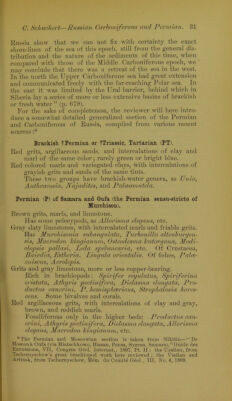
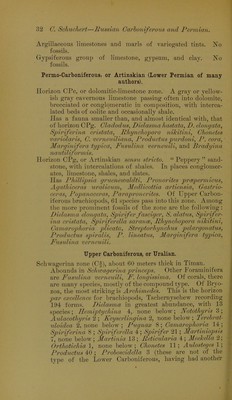
![These make it clear that this is not the normal marine fauna that continues the Paleozoic sequence into the Mesozoic. This point, however, will be discussed on a later page (see “Conclusions,” paragraph 2). In regard to the Russian faunas the author states :— “I wish to call attention to the decided differences which make their appearance in the fauna of the Omphalotroclius horizon when contrasted with the type of that of Miatschkowo [near Moscow; also see the following table for stratigraphic position], and on the other hand the great resemblance of the brachiopod fauna of the Schwagerina zone to that of the higher lying Permo-Carbon (the Artinsk deposits CPg and the Lime- stone-dolomite CPc). In the lower Permian fauna of Russia we have already noted a decided reduction in Brachipoda, if not in quantity, at least in variety of species; and in the still higher horizons of the Russian Permian, the total number of Brachiopoda is not more than 40 species [this number has reference to all areas correlated with the typical Perm area]. Entire groups of forms . . . that give a decided aspect to the fauna of the Upper Carboniferous Artinsk, and the Limestone-dolomite beds, are completely unknown in the Per- mian sediments of Russia and west Europe. Some of these groups therefore attract our attention because they are foreign to the Permian deposits, yet in the Mesozoic (Trias and Jura) they attain an extended development. On the other hand, others belong to such original types as the Lyttoniidie, Teguli- fera, and Orthotichia, forms that give a decided character to the upper Paleozoic, and, so far as our knowledge goes, com- pletely disappear with the Permian epoch [of western Europe]. From a biological standpoint there can be no doubt that our Upper Carboniferous brachiopod fauna has the facies of a younger type than the Permian, and that in its entirety it has a more decided Mesozoic impress than that of the [Russian] Permian following, which when compared with the other shows atavistic trends [see note 6]. As it is my opinion that this atavism finds its proper explanation in the physico-geo- graphic conditions of the Permian sea, I hold that it is not superfluous to direct special attention to this fact, and thereby to moderate the tendency of some geologists, who in their determination of the age of this or that fauna depend mainly upon the biological peculiarities and not infrequently leave out of consideration the possible explanation that the biological differences between two synchronous or at least closely adjoin- ing faunas are partially due to facies and chorological causes” (pp. 663-4). ' ... “ Although the data presented regarding the distribution of Upper Carboniferous deposits in the region of European](https://iiif.wellcomecollection.org/image/b22407194_0006.jp2/full/800%2C/0/default.jpg)