The Russian Carboniferous and Permian compared with those of India and America : a review and discussion / by Charles Schuchert.
- Charles Schuchert
- Date:
- 1906
Licence: In copyright
Credit: The Russian Carboniferous and Permian compared with those of India and America : a review and discussion / by Charles Schuchert. Source: Wellcome Collection.
Provider: This material has been provided by The Royal College of Surgeons of England. The original may be consulted at The Royal College of Surgeons of England.
9/38 page 35
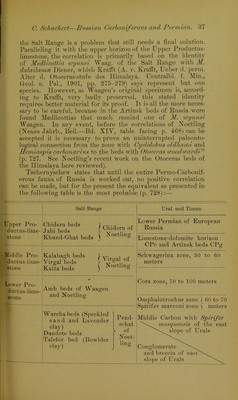
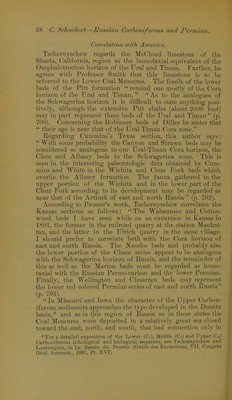
![Of the many Indian species of Brachiopoda, the author finds that 31 are also known in the Ural-Timan region. To these he lias added 13 other species not common to both areas, but which clearly have related forms. He then discusses the dis- tribution of these various species in the beds of India and the Ural-Timan region, and concludes:— “ Of great significance is the occurrence of the family Lytton- iidm in the Schwagerina horizon of the Ural and the Virgal beds of India. This occurrence is of great moment and signifi- cance in the history of the upper Paleozoic of Russia ” (see “ Conclusion,” paragraph 5). “ Through a comparison of the brachiopod fauna of the Upper Carboniferous deposits of the Ural and Timan with those of the various subdivisions of the Productus-limestone of the Salt Range, we clearly see that the lower Productus-limestone, or the Amb beds [see tables on pp. 32, 37], is more properly correlated with the Ural-Timan horizon having Spirifer mar- coui and Omphalotrochus whitneyi, and that in our Schwag- eriua horizon we more naturally may discern the greater part of the Middle Productus-limestone, while the homotaxial sedi- ments of the Cora horizon we have to seek in the upper layers of the Amb beds and probably also in the lower horizons of the Middle Productus-limestone, or in the Virgal group (ac- cording to Noetling’s nomenclature). In this parallelism the Kalabagh beds [upper division of the Middle Productus-lime- stone] and the Upper Productus-limestone (in any event, the major part) well represent the Artinsk deposits and their equiva- lents of the Ural.” “This result is in the main at variance with the prevail- ing views as to the age of the various subdivisions of the Pro- ductus-limestone of the Salt Range, and approaches decidedly the original conclusion that the age of these beds is Carbonifer- ous. I foresee that against my deductions the objection will be raised that they are based on a comparison of the brachiopods alone, but I can also defend them through other classes of the animal world. Moreover, I wish to say a few words in regard to the Cephalopoda, especially the ammonites.” He then dis- cusses the ammonites of Russia and Sicily, as described by Karpinsky and Gemmellaro, and lays particular stress upon the conclusion of the former, which he quotes as follows: “ That the Sicilian fauna is somewhat earlier in origin than that of the Urals, although they, as I will again assert, approach closely the Artinsk. On the other hand, it is possible that the differences mentioned are due to chorological causes. The complicated Arcestidse, for instance, can only belong to the southern regions” (pp. 719-20).](https://iiif.wellcomecollection.org/image/b22407194_0011.jp2/full/800%2C/0/default.jpg)