The Hindu-Arabic numerals / by David Eugene Smith and Louis Charles Karpinski.
- David Eugene Smith
- Date:
- 1911
Licence: In copyright
Credit: The Hindu-Arabic numerals / by David Eugene Smith and Louis Charles Karpinski. Source: Wellcome Collection.
30/184 page 18
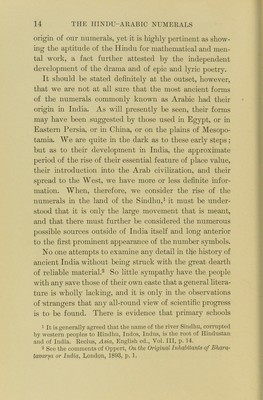
![also speak of eighteen ancient Siddhantas or astronomical works, which, though mostly lost, confirm this evidence.1 As to authentic histories, however, there exist in India none relating to the period before the Mohammedan era (622 A.D.). About all that we know of the earlier civi- lization is what we glean from the two great epics, the Mahabharata 2 and the Ram ay an a, from coins, and from a few inscriptions.3 It is with this unsatisfactory material, then, that we have to deal in searching for the early history of the Hindu-Arabic numerals, and the fact that many unsolved problems exist and will continue to exist is no longer strange when we consider the conditions. It is rather surprising that so much has been discovered within a century, than that we are so uncertain as to origins and dates and the early spread of the system. The probabil- ity being that writing was not introduced into India before the close of the fourth century b.c., and literature existing only in spoken form prior to that period,4 the number work was doubtless that of all primitive peoples, palpable, merely a matter of placing sticks or cowries or pebbles on the ground, of marking a sand-covered board, or of cutting notches or tying cords as is still done hi parts of Southern India to-day.5 1 For a list and for some description of these works see R. C. Dutt, A History of Civilization in Ancient India, Vol. II, p. 121. 2 Professor Ramkrishna Gopal Bhandarkar fixes the date as the fifth century b.c. [“Consideration of the Date of the Mahabharata,” in the Journal of the Bombay Brandi of the E. A. Soc., Bombay, 1873, Vol. X, p. 2.] 3 Marshman, loc. cit., p. 2. 4 A. C. Burnell, South Indian Palaeography, 2d ed., London, 1878, p. 1, seq. 5 This extensive subject of palpable arithmetic, essentially the history of the abacus, deserves to be treated in a work by itself.](https://iiif.wellcomecollection.org/image/b24863816_0030.jp2/full/800%2C/0/default.jpg)



 No text description is available for this image
 No text description is available for this image
 No text description is available for this image