Volume 1
A textbook of pathology : systematic & practical.
- Hamilton, David James.
- Date:
- 1889-94
Licence: Public Domain Mark
Credit: A textbook of pathology : systematic & practical. Source: Wellcome Collection.
Provider: This material has been provided by Royal College of Physicians, London. The original may be consulted at Royal College of Physicians, London.
70/780
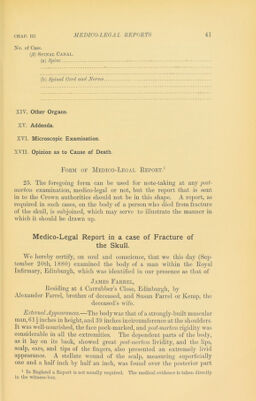
![of the right parietal region. It passed down to the bone so as to expose this. The hair surrounding the wound was saturated with partially dried blood, and several spots of dried blood were also noticed upon the face and neck. The Head.—The loose tissues between the scalp and the skull were found to contain a little recently extravasated blood for a distance of about half an inch to an inch around the wound. There was no sign of a bruise at any other part of the scalp. An enormous recent clot of blood was found covering the whole left hemisphere of the brain situated between the Arachnoid and Dura i\Iater (two of the membranes covering the brain). It measured one quarter of an inch in thickness about the middle of the hemisphere. The brain at this part, and in fact over the whole hemisphere, was much compressed by the effused blood. The opposite side of the brain, although it was free from extravasated blood, was very dry and flat- tened. The tip of the left temporo-sphenoidal lobe (the middle lobe of the organ) was severely lacerated to a depth of about one-eighth to one-quarter inch. A large clot of blood lay firmly in contact with it. The interior of the brain did not present any abnormality. The Skull had sustained a linear fracture of the right half of its occipital bone which extended upwards into the lower posterior angle of the right parietal bone. The length of the fracture was four and a half inches. A little recently extravasated blood was found within the fissure. The Stomach smelt strongly of alcohol, and contained about three ounces of half-digested food. Other organs normal. Opinion as to Cause of Death.—From the above examination we are of opinion that the deceased James Farrel died from haemorrhage over the brain, the result of a fracture of the skull. Signed , M.D. (Do.) M.D. Edinburgh, September 20, 1880. Affixing of Labels.—Where it is necessary in forensic cases to retain the contents of the stomach, bladder, etc., or portions of organs for analysis or further examination, they should be placed in clean, un- used bottles or jars. The bottles should be sealed, and a label affixed, descriptive of the contents, signed by the two subscribers to the report. Literature Treating GeneruXhj of rost-mortem Examinations.—Babes (P. M. Exams, with a view to Bacteriological Kesearch) : Arch. Ronm. de Med. et Chir., i. 1887, p. 157. Bourneville and Bricon : Manuel de Technique des Autopsies, 1885. Harris : Post-mortem Handbook, 1887. Orth : Com]tend of Diagnosis in Path. Anat. (Eng. tramsl. by Shattuck and Sabine). Virchow : Post-mortem Examinations (Eng. trausl. by Smith). Woodhead: Practical Pathology, 1885, p. 1.](https://iiif.wellcomecollection.org/image/b24990607_0001_0070.jp2/full/800%2C/0/default.jpg)