Volume 1
A textbook of pathology : systematic & practical.
- Hamilton, David James.
- Date:
- 1889-94
Licence: Public Domain Mark
Credit: A textbook of pathology : systematic & practical. Source: Wellcome Collection.
Provider: This material has been provided by Royal College of Physicians, London. The original may be consulted at Royal College of Physicians, London.
83/780
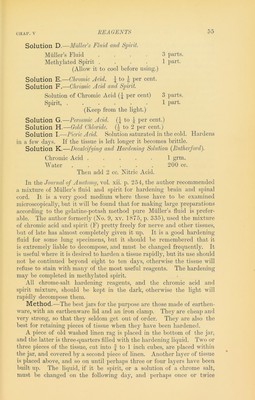
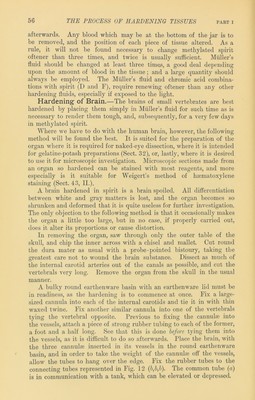
![Solution D.—MiilleEs Fluid and Spirit. Miiller’s Fluid .... 3 parts. ]\Ieth}dated Spirit .... 1 part. (Allow it to cool before using.) Solution E.—Chromic Acid. ^ to per cent. Solution F.—Chromic Acid and Spirit. Solution of Chromic Acid per cent) 3 parts. Spirit, ...... 1 part. (Keep from the light.) Solution G.—Perosmic Acid. (^ to ^ per cent.) Solution H.—Gold Chloride. (^ to 2 per cent.) Solution I.—Picric Acid. Solution saturated in the cold. Hardens in a few days. If the tissue is left longer it becomes brittle. Solution K.—Decalcifying and Hardening Solution (Itutherford). Chromic Acid ..... 1 grm. Water . . . . . . 200 cc. Then add 2 cc. Nitric Acid. In the Journal of Anatomy, vol. xii. p. 254, the author recommended a mixture of Mtiller’s fluid and spirit for hardening brain and si)inal cord. It is a very good medium where these have to be examined microscopically, but it will be found that for making large preparations according to the gelatine-potash method pure Muller’s fluid is prefer- able. The author formerly (No. 9, xv. 1875, p. 335), used the mixture of chromic acid and spirit (F) pretty freely for nerve and other tissues, but of late has almost completely given it up. It is a good hardening fluid for some lung specimens, but it should be remembered that it is extremely liable to decompose, and must be changed frequently. It is useful where it is desired to harden a tissue rapidly, but its use should not be continued beyond eight to ten days, otherwise the tissue will refuse to stain with many of the most useful reagents. The hardening may be completed in methylated spirit. All chrome-salt hardening reagents, and the chromic acid and spirit mixture, should be kejA in the dark, otherwise the light will rapidly decompose them. Method.—The best jars for the purpose are those made of earthen- ware, with an earthenware lid and an iron clamjD. They are cheap and very strong, so that they seldom get out of order. They are also the best for retaining pieces of tissue when they have been hardened. A piece of old washed linen rag is placed in the bottom of the jar, and the latter is three-quarters filled with the hardening liquid. Tav'o or three pieces of the tissue, cut into to 1 inch cubes, are placed Avithin the jar, and covered by a second piece of linen. Another layer of tissue is placed above, and so on until perhaps three or four layers have been built up. The liquid, if it be spirit, or a solution of a chrome salt, must be changed on the folloAving day, and perhaps once or tAvice](https://iiif.wellcomecollection.org/image/b24990607_0001_0083.jp2/full/800%2C/0/default.jpg)