Volume 1
A textbook of pathology : systematic & practical.
- Hamilton, David James.
- Date:
- 1889-94
Licence: Public Domain Mark
Credit: A textbook of pathology : systematic & practical. Source: Wellcome Collection.
Provider: This material has been provided by Royal College of Physicians, London. The original may be consulted at Royal College of Physicians, London.
87/780
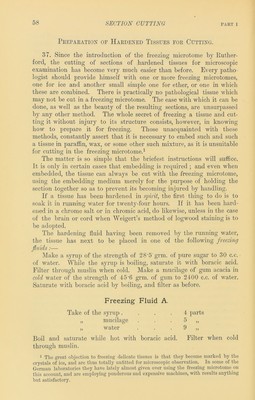
![Freezing Fluid B. Take of Freezing Fluid “ A ” . „ syrup 2 parts 1 part Freezing Fluid C. Take of syrup .... 4 parts „ mucilage . . . . 5 „ These three fluids freeze with different degrees of hardness. That marked “ A ” freezes very easily ; that marked “ B ” is more difficult to freeze ; while that marked “ C ” just freezes, but with considerable difficulty, a very low temperature being necessar}^ According to the delicacy of the tissue, it ought to be placed in one or other of these fluids before being cut. For b}^ far the greater number of tissues, the “A” fluid is sufficiently strong, but it may happen that we have to do wuth a very delicate structure and one which cannot be hardened to any great extent without being spoiled. In such a case the “B” fluid should be preferred; while very exceptionally it happens that in order to prevent the ice injuring the tissue it is necessary to employ the “C ” freezing fluid. This, however, is rare. The time required to soak the pieces of tissue varies according to their size and other circumstances, such as the presence of adipose tissue round them. It is always safe to give a week’s time wuth any of them. Instead, however, of merely soaking portions of the tissue as they are required, it is much better to keej) all hardened tissues permanently in the fluid. The longer they are kept the better, for, as time goes on, the piece of the morbid organ or tumour, as the case may be, becomes satu- rated with the solution in every part, and cuts ■without any tearing or irregularity. It is often said that the freezing microtome tears the sections. Such a libel is unjustifiable ; should the tissue be injured, it is owing to its having been imperfectly soaked with a ])VO'])Qr freezing fluid. The next thing to be done, therefore, after the hardening fluid has been got rid of, is to put the piece of tissue in a stone-ware jar with sufficient freezing fluid of either of the three strengths to cover it. Put a label on the jar with a number corresponding to a duplicate in a catalogue. The jar may be filled with different organs and tissues, provided that they are of sufficiently distinctive appearance to be recognised. Thus pieces of kidney, liver, lung, and a tumour may be retained in the same jar, if the label outside states distinctly what is in it, and refers each to the number of the jar kept in the catalogue. In this way much space is saved, where many tissues have to be stored. The convenience of having each of these in a state fit for freezing at any time Avill be readily appreciated. It is well to place every tissue first in the “A” fluid and to freeze a piece in order to see whether the solution is strong enough. If it is found that the tissue has been injured by the ice, soak another](https://iiif.wellcomecollection.org/image/b24990607_0001_0087.jp2/full/800%2C/0/default.jpg)