Volume 1
A textbook of pathology : systematic & practical.
- Hamilton, David James.
- Date:
- 1889-94
Licence: Public Domain Mark
Credit: A textbook of pathology : systematic & practical. Source: Wellcome Collection.
Provider: This material has been provided by Royal College of Physicians, London. The original may be consulted at Royal College of Physicians, London.
91/780
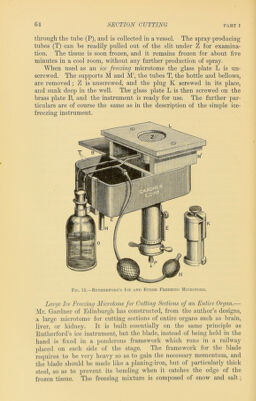
![now placed in alternate layers in tlie freezing box, and vigorously stirred with some suitable instrument. The salt is apt to accumulate at the innermost part of the freezing box, and must from time to time be cleared out. The drainage pipe of the freezing box must be closed with a cork. The freezing will proceed very much quicker if this is attended to, and the object frozen can be left for a greater length of time, without renewing the mixture, if the liquid is retained. It should be allowed to escape only when it becomes excessive. When the temperature of the plug has been reduced to freezing point, which may be ascertained by touching it with a damp finger, suffi- cient mucilage (Phar. Brit.), is poured into the cylinder to form a layer about one-eighth of an inch deep. This is allowed to freeze before putting ill the piece of tissue. The latter, taken out of the freezing fluid, is now placed in the cylinder with a pair of dissecting forceps, and held in position until it adheres to the side of the cylinder. It should always be held in contact with the side of the cylinder farthest away from the operator. The tissue is surrounded, lastly, with mucilage, and a piece of strong waterproof texture of any kind, covered by a weight, is put over the mouth of the cylinder to prevent the freezing mixture accidentally entering. The best blade to employ is that proposed by Deffipine, and con- sists of an ordinary planing iron set in a wooden handle. Nothing could be more efficacious than this knife, and as its cost is so insignifi- cant, several of them may be at hand, ready for use, although they require to be sharpened only very seldom. The handlfe is held firmly in the palm of the right hand, and the blade is pressed closely down on the glass plate of the microtome at an angle of something like 45°. With the left hand the tissue to be cut is screwed u])wards, while the blade is kept continuously playing over the surface. As many as fifty sections may be cut in a single series, and as they are cut they accumulate on the back of the blade. They are afterwards trans- ferred to a basin of water and allowed to unfold. AYith very delicate tissues, such as brain or spinal cord, it is better to cut each singly; but with liver, kidney, lung, etc., a huge mass of them can be swept off continuously without injury. As many as from two hundred and fifty to three hundred sections may be cut in a minute by this means, all of exquisite delicacy and uninjured. ItutherfOrel’s Ice and Ether Freezing Microtome.—Professor Euther- ford has further adapted the preceding instrument for freezing with ether, by which means it has been rendered doubly serviceable. The price, moreover, is less than that of two separate microtomes. When used with ether spray, the instrument is arranged as shown in the woodcut (Fig. 13). The tissue, which should not be more than a third of an inch thick, is laid on the zinc plate (Z) and covered with gum. Ether, which must be anhydrous, is then blown from the bottle (0), by the elastic bellows (N), against the lower surface of the zinc plate. Any ether which may escajDe volatilisation flows down](https://iiif.wellcomecollection.org/image/b24990607_0001_0091.jp2/full/800%2C/0/default.jpg)