Outlines of physical chemistry / by A. Reychler ; translated form the French with the author's permission by John McCrae.
- Reychler, A. (Albert), 1854-
- Date:
- 1904
Licence: In copyright
Credit: Outlines of physical chemistry / by A. Reychler ; translated form the French with the author's permission by John McCrae. Source: Wellcome Collection.
25/302 page 5
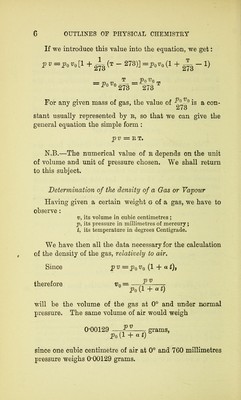
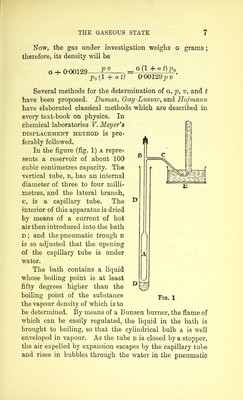
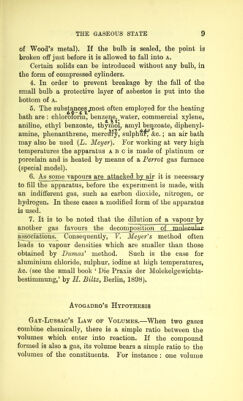
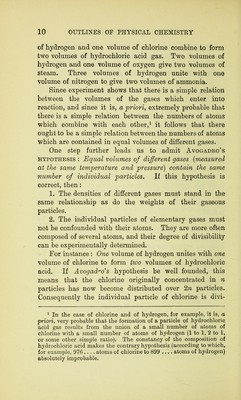
![hence: v = v0 (1 + « t). If the temperature of a gas be raised without allowing it to expand, the pressure increases according to the formula : p=]?o{l + «*)• By combining these two equations we get the General Equation of a Gas : pv=p0v0(l + a*).1 This equation can be arrived at directly from the following considerations. Let v0 be the volume of a gaseous mass at 0° and under the normal pressure p0 (76 centi- metres of mercury), then the volume at t° under the same pressure will be (1 + a t). Let the pressure be now reduced to 1 centimetre of mercury, then the volume will increase to v0 (1 + a t)p0, and if the gas be now compressed to the pressure p the final volume will be v = PoM± + «0 p or p V = p0 V0 (1 + a t). Transformation of the General Equation : pv=p0v0 (1 + at). At £°,the absolute temperature (counting from — 273° C.) will be T = 273 + t. Therefore t = t - 273. ’ « = volume6 } at the temperature t = normal atmospheric pressure = 760 millimetres of mer- cury. v9 = volume at 0° under normal pressure.](https://iiif.wellcomecollection.org/image/b2813400x_0025.jp2/full/800%2C/0/default.jpg)


 No text description is available for this image
 No text description is available for this image
 No text description is available for this image