The microscope and microscopical technology : a textbook for physicians and students / by Heinrich Frey ; translated from the German and edited by George R. Cutter, from the fourth and last German edition.
- Date:
- 1872
Licence: Public Domain Mark
Credit: The microscope and microscopical technology : a textbook for physicians and students / by Heinrich Frey ; translated from the German and edited by George R. Cutter, from the fourth and last German edition. Source: Wellcome Collection.
Provider: This material has been provided by the Royal College of Physicians of Edinburgh. The original may be consulted at the Royal College of Physicians of Edinburgh.
33/686 (page 15)
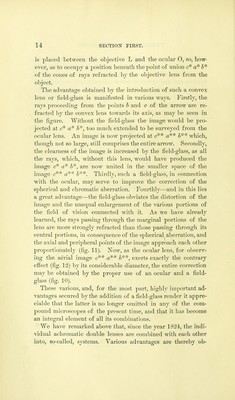
![tained. It is very difScult to construct a double lens of crown and flint glass with a short focus, while several weaker ones combined give the same magnifying power as the simple objec- tive, and are much easier to make. Then, as we have also seen, by the combination of a single crown and flint glass lens, whereby, also, a small angle of aperture must always be given to the lens, the spherical and chromatic aberration are essentially lessened, but not entirely obviated. By a suitable combination of several double lenses, where the aberrations of one lens are made to correct the opposite ones of an- other, a considerable further correction is obtained, c* i- and a much larger angle of aperture may be used; in this manner the greatly improved lenses of our microscopes of the present day are produced. In these only two, or, at most, three double lenses are combined with each other (fig. 16). The earlier opticians generally designated the several double lenses by a series of numbers, 1, 2, 3-6, the weakest bearing the lowest number, and screwed them together into a system (for example, achromatic ob- o t/ \ IT 7 ]ective and its i, 2, 3, and 4, 5, 6). In this way, with a moderate l^l^ °^ ^p'^'^- mimber of single lenses, a series of systems may be constructed, it is true; but two things which are of greater importance, the accurate centering (that is, the falling together of the axes of the lenses in a single straight line) and the proper distancing of the single lenses from each other, cannot be so accixrately accomplished as -where these are permanently com- bined with each other in systems. The preference has, there- fore, very properly been given to the latter arrangement, and, though the former is the least expensive, it should be entirely discarded. The peraianent systems are variously designated by the opticians; either by numerals increasing with the strength of the combination, or by a series of letters. The manner of expression of the English opticians is peculiar. They speak of Jg^-, of an inch combinations of lenses, making the in- crease of the strength of their systems the same as that of a simple lens of ^, \, inch focus. The combination of the three achromatic lenses with each](https://iiif.wellcomecollection.org/image/b21938441_0033.jp2/full/800%2C/0/default.jpg)