The administrative structure of the health and personal social services in Northern Ireland.
- Northern Ireland
- Date:
- 1969
Licence: Public Domain Mark
Credit: The administrative structure of the health and personal social services in Northern Ireland. Source: Wellcome Collection.
23/40 page 21
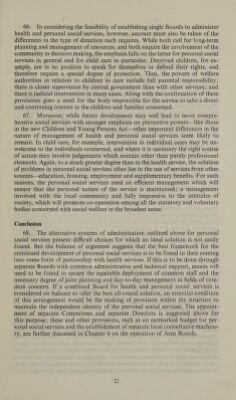
![66. In considering the feasibility of establishing single Boards to administer health and personal social services, however, account must also be taken of the differences in the type of direction each requires. While both call for long-term planning and management of resources, and both require the involvement of the community in decision making, the emphasis falls on the latter for personal social services in general and for child care in particular. Deprived children, for ex- ample, are in no position to speak for themselves or defend their rights, and therefore require a special degree of protection. Thus, the powers of welfare authorities in relation to children in care include full parental responsibility; there is closer supervision by central government than with other services; and there is judicial intervention in many cases. Along with the continuation of these provisions goes a need for the body responsible for the service to take a direct and continuing interest in the children and families concerned. 67. Moreover, while future development may well lead to more compre- hensive social services with stronger emphasis on preventive powers—like those in the new Children and Young Persons Act—other important differences in the nature of management of health and personal social services seem likely to remain. In child care, for example, intervention in individual cases may be un- welcome to the individuals concerned, and where it is necessary the right course of action may involve judgements which contain other than purely professional elements. Again, to a much greater degree than in the health service, the solution of problems in personal social services often lies in the use of services from other sources—education, housing, employment and supplementary benefits. For such reasons, the personal social services need an efficient management which will ensure that the personal nature of the service is maintained; a management involved with the local community and fully responsive to the attitudes of society, which will promote co-operation among all the statutory and voluntary bodies concerned with social welfare in the broadest sense. Conclusion 68. The alternative systems of administration outlined above for personal social services present difficult choices for which an ideal solution is not easily found. But the balance of argument suggests that the best framework for the continued development of personal social services is to be found in their coming into some form of partnership with health services. If this is to be done through separate Boards with common administrative and technical support, means will need to be found to secure the equitable deployment of common staff and the necessary degree of joint planning and day-to-day management in fields of com- mon concern. If a combined Board for health and personal social services is considered on balance to offer the best all-round solution, an essential condition of this arrangement would be the making of provision within the structure to maintain the independent identity of the personal social services. The appoint- ment of separate Committees and separate Directors is suggested above for this purpose; these and other provisions, such as an earmarked budget for per- sonal social services and the establishment of separate local consultative machine- ry, are further discussed in Chapter 6 on the operation of Area Boards. 2]](https://iiif.wellcomecollection.org/image/b32184517_0023.jp2/full/800%2C/0/default.jpg)
 No text description is available for this image
 No text description is available for this image
 No text description is available for this image