Anthropology : an introduction to the study of man and civilization / by Edward B. Tylor.
- Tylor Edward Burnett, Sir, 1832-1917.
- Date:
- 1881
Licence: Public Domain Mark
Credit: Anthropology : an introduction to the study of man and civilization / by Edward B. Tylor. Source: Wellcome Collection.
Provider: This material has been provided by the Royal College of Physicians of Edinburgh. The original may be consulted at the Royal College of Physicians of Edinburgh.
65/504 page 45
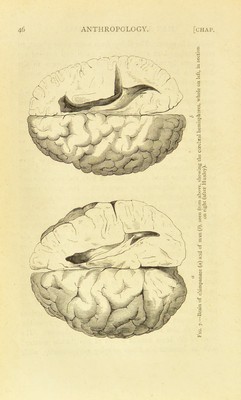
![n.] forehead in anger. The visitor from some other planet, so often imagined as coming to our earth and forming his judgments by what he sees, might well discern in the difference between man’s face and the gorilla’s muzzle some measure of the discrepancy within. The brain being the instrument or organ of mind, anatomists comparing the brains of animals have looked for well-marked distinctions between the less and the more intelligent. In the natural order of Primates, to which man belongs with the monkeys and lemurs, the series of brains shows a remarkable rise or development from lower to higher forms. The lemur has a small and comparatively smooth brain, whereas the high anthropoid apes have brains which strikingly approach man's. In fact the lemur has very little mind in comparison with the sagacious and teachable chimpanzee or orang-utan. But man’s reason so vastly surpasses that of the highest apes, that naturalists have wondered at the likeness of their brain to ours, which is illustrated in the accompanying Fig. 7, representing the brain of the chimpanzee a, and of man b, whole on the left to show the convolutions, and cut across on the right to expose the interior. To compare their structure the two brains are drawn of the same size, but in fact the chimpanzee brain is much smaller than the human. It is one great difference between man and the anthropoid apes, that his brain exceeds theirs in quantity; in a rough way he has three pounds of brain to their one. It is seen also that in the ape-brain the lobes or hemispheres have fewer and simpler windings than the more complex convolutions of the human brain, which in general outline they resemble. Now both size and complexity mean mind-power. The lobes df the brain consist within of the “ white matter ” with its innumerable fibres carrying nerve-currents, while](https://iiif.wellcomecollection.org/image/b21689969_0065.jp2/full/800%2C/0/default.jpg)