The constituents of the flowering tops of Aretemisia afra, Jacq / by John Augustus Goodson.
- Goodson, John Augustus.
- Date:
- [1921]
Licence: Public Domain Mark
Credit: The constituents of the flowering tops of Aretemisia afra, Jacq / by John Augustus Goodson. Source: Wellcome Collection.
4/12 page 490
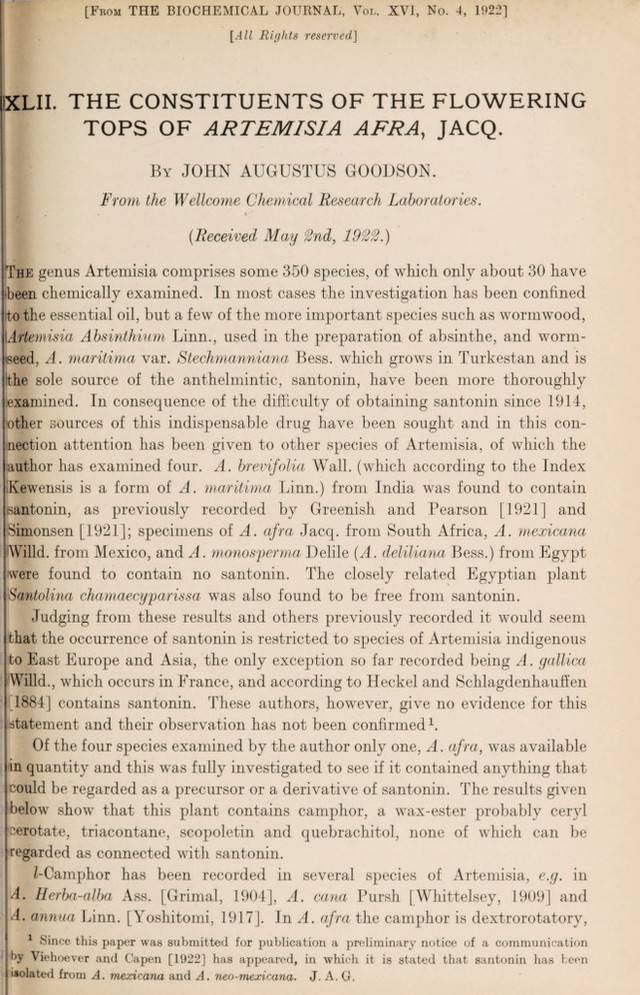
![4m fj. v*vn but the rotation is much lower than that of normal d-camphor. Two specime: i were found to have [a]^° + 9*7° and [a]™ + 9-3° instead of [a]£° + 42-411: As it is usually considered that only two optically active isomerides can exi t* notwithstanding the fact that the camphor molecule contains two asyE if metric carbon atoms, and as camphor is not easily racemised, it would appeiijl* that both d- and Lcamphor are present in A. afra. It may be noted tkfj' inactive camphor has been found in Chrysanthemum sinense var. japonicu: [Keimatsu, 1909]. Scopoletin and quebrachitol have not been recorded previously in tt ft genus Artemisia or even in the natural order Compositae. The former h.£ || been found in Atropa Belladonna Linn. [Kunz, 1885], Fahiana imbricata Rui j et Pav. [Kunz-Krause, 1899] and Scopolia japonica Maxim. [Eykman, 1884 of the natural order Solanaceae; Ipomoea purga Hayne (Convolvulaceae [Power and Pogerson, 1910]; Gelsemium sempervirens Ait. (Loganiacea [Moore, 1910] and Prunus serolina Ehrh. (Rosaceae) [Power and Moore, 1909 f| Quebrachitol has only been found in four other plants, viz. Aspidosperm quebracho Schlect (Apocyanaceae) [Tanret, 1889]; Grevillea robusta A. Cun:j| (Proteaceae) [Bourquelot and Fichtenholz, 1912]; Heterodendrum oleaefolium Desf. (Sapindaceae) [Petrie, 1918] and Hevea brasiliensis Muell. (Euphorbias ceae) [Pickles and Whitfield, 1911], all of which belong to different natura l orders. The other components ceryl cerotate and triacontane are fairly wideb f distributed in plants. r I tfi Experimental. For the material used in this investigation the author is indebted to Mi |L I. B. Pole Evans, Chief of the Division of Botany, Union of South Africa II It consisted of the flowering tops of the plant including stems, leaves anoit florets. When extracted with Prollius’s fluid it yielded a mere trace of alkaloid f and furnished the following percentages of extract on exhaustion in a Soxhleti apparatus with solvents in the order named: petroleum (b.p. 35-60°), 7-0; - ether, 9-5; chloroform, 2-1; ethyl acetate, 3-4; alcohol, 15-5. Special search) was made for santonin with negative results. For the purpose of a morel complete examination a quantity (11-1 kilograms) was extracted in succession; with hot solvents, petroleum (b.p. 35-60°), ether and alcohol. The alcoholic extract was further fractionated by drying on a quantity of the flowering tops previously exhausted with petroleum and ether and re-extracting hot with chloroform, ethyl acetate and alcohol in succession. The petroleum extract on distillation in steam and extraction of the distillate with ether yielded 55-2 g. of essential oil; a further 28-6 g. was subsequently obtained from the ether extract, equivalent in all to 0-75 % by weight of the flowering tops. The material left behind in the distillation flask on boiling with petroleum (b.p. 35 to 60°), deposited on cooling about 81 g. of crude wax-ester melting at 74-76°. The residue left on removal of the petroleum was boiled with ether](https://iiif.wellcomecollection.org/image/b3062339x_0004.jp2/full/800%2C/0/default.jpg)