The child : a study in the evolution of man / by Alexander F. Chamberlain.
- Alexander Francis Chamberlain
- Date:
- 1900
Licence: In copyright
Credit: The child : a study in the evolution of man / by Alexander F. Chamberlain. Source: Wellcome Collection.
Provider: This material has been provided by UCL Library Services. The original may be consulted at UCL (University College London)
43/538 (page 25)
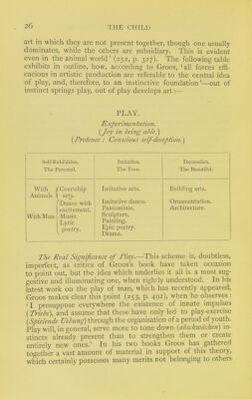
![Filling from time to time his humorous stage With all the persons, down to palsied age, That Life brings with her in her equipage. Thus in imitation play, in obedience to the biologic law of recapitulation, the child epitomises and rehearses the funda- mental experiences of the race, at the same time that he is sounding the depths and shoals of his own nascent powers, and thereby preparing day by day to take part in the real work of Ufe which the coming years will bring. Play is thus seen to be at once reminiscent and anticipatory, a welding of the future to the past.' And all over this child's season of appren- ticeship, his Wanderjahre, is written, for the adult noli me tangere^ let well enough alone. Groos's Theory of Play.—Professor Karl Groos, of Basel, who holds that ' the play of the young being once successfully solved, the play of the adult will offer no special difificulties,' maintains that 'the play of youth depends on the fact that certain instincts [with Ziegler and Weismann, Dr Groos refers all instincts to natural selection], especially useful in preserv- ing the species, appear before the animal seriously needs them. They are, in contrast with later serious exercise {Aicsiibung), a preparation {Voriibung) and practice {Eitiiibung) for the special instincts' (252, p. xx.). The biological significance of play seems to lie in the fact that ' perhaps the very existence of youth is due in part to the necessity for play; the animal does not play because he is young, he has a period of youth because he must play.' According to Groos, 'the psychic ac- companiment of the most elementary of all plays, namely, experimentation, is joy in being a cause,' and the more subtle psychic phenomenon connected with the subject' make- believe, or conscious self-illusion.' Experimentation, ' the commonest of all kinds of play,' is to be looked upon as the principal source of all kinds of art.' ' From experimenta- tion in general,' says Groos, ' three specialised forms of play arise, analogous to the human arts, and their differentiation leads us to the three most important principles of the latter. 1 hey are courtship, imitation, and the constructive arts, and the three principles involved are those of self-exhibition, imita- lon and decoration. These principles are expressed in art as the personal, the true, and the beautiful. There is no form of](https://iiif.wellcomecollection.org/image/b21686609_0043.jp2/full/800%2C/0/default.jpg)