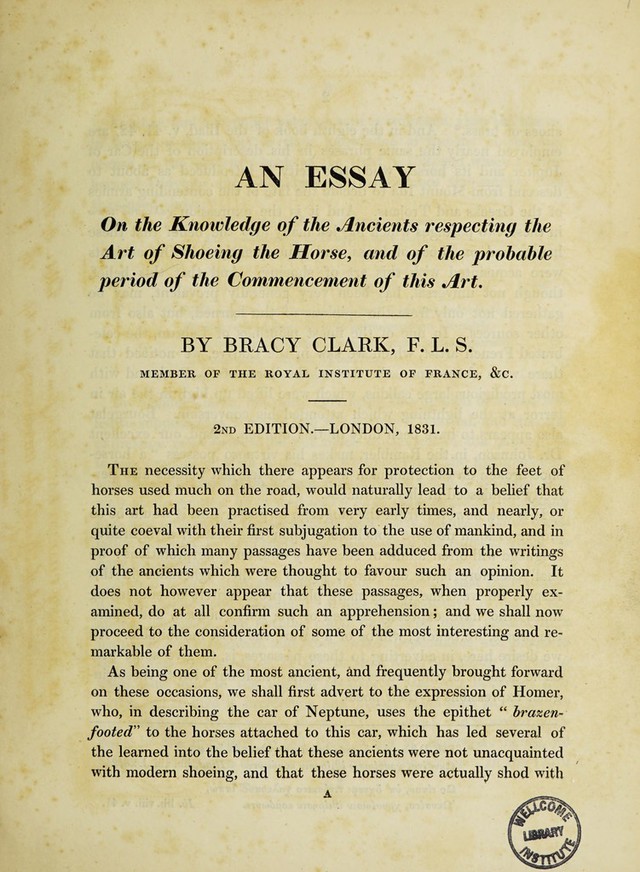
An essay on the knowledge of the ancients respecting the art of shoeing the horse, and of the probable period of the commencement of this art / [Bracy Clark].
- Bracy Clark
- Date:
- [1831]
Licence: Public Domain Mark
Credit: An essay on the knowledge of the ancients respecting the art of shoeing the horse, and of the probable period of the commencement of this art / [Bracy Clark]. Source: Wellcome Collection.
4/38 page 2
![shoes of brass.* And in the eighth book of the Iliad, v. 41, 42, are employed nearly the same phrases in his description of the Car of Jupiter and its horses, when this deity is introduced as about to descend from Mount Ida to decide the fate of the contending armies of the Greeks and Trojans. And it is the expression xa^K07r0^ t7r7rw in these two passages which has led many into the belief that these horses had on shoes of brass, and consequently that the ancients were acquainted with this art of shoeing. And that this belief, though not universal, has been very generally prevalent, may be gathered not only from the opinions of the learned, but also from other sources. In one of the finest paintings of Lebrun, the cele¬ brated French artist, which we saw in the Louvre, we noticed that there were shoes upon the feet of the horse of St. Paul, and with most prodigious large calkins, which were lifted up high in the air in terror at the lightning which attended his conversion. Bourgelat also appears to have been fully of this opinion. And our excellent Dr. Johnson, in the Rambler, makes his virtuoso possess “a horse¬ shoe broken on the Flaminian way.” The learned Vossius also per¬ fectly acquiesced in this sentiment. It is not, however, from the language of poetry that it would be so proper to form decisive conclusions upon this matter, as figurative language will often admit of such very different interpretations : we shall therefore leave our direct proofs of their ignorance in this respect till we come to the more plain prose writers of succeeding times who have expressly treated of the horse himself, and where the proofs, we believe, will be of a nature the most indubitable. All we desire here, in adverting to these passages, is, to give some pro¬ bable account of the causes or reasons which have led to those sin¬ gular expressions of their poets. ’ EvO’ eXOmv, vtt’ o^err<fu titvgkbto ^aX/coiroS’ i7r7ra), Qkvttetci, xQvatoiaiv Wdprjaiv ko/howvte. Iliad, lib. xiii. 1. 23,24. lie ELTTOVj inr’ Oyt<J([>l TITVCTICETO ^aXK07ToS’ 17T7TIV, ’S^KUTtra, xpvcrioicnv We[pr]<nv kopowvrE. lb. lib. viii. v. 41.](https://iiif.wellcomecollection.org/image/b31872931_0004.jp2/full/800%2C/0/default.jpg)