Licence: Public Domain Mark
Credit: Monthly nursing. Source: Wellcome Collection.
Provider: This material has been provided by the Francis A. Countway Library of Medicine, through the Medical Heritage Library. The original may be consulted at the Francis A. Countway Library of Medicine, Harvard Medical School.
231/268 page 223
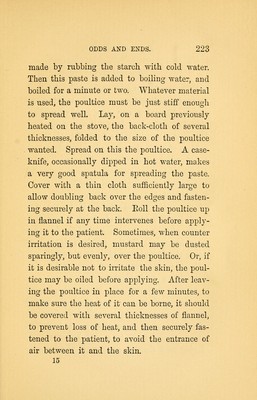
![made by rubbing the starch with cold water. Then this paste is added to boiling water, and boiled for a minute or two. Whatever material is used, the poultice must be just stiff enough to spread well. Lay, on a board previously heated on the stove, the back-cloth of several thicknesses, folded to the size of the poultice wanted. Spread on this the poultice. A case- knife, occasionally dipped in hot water, makes a very good spatula for spreading the paste. Cover with a thin cloth sufficiently large to allow doubling back over the edges and fasten- ing securely at the back. Eoll the poultice u]3 in flannel if any time intervenes before apply- ing it to the patient. Sometimes, when counter irritation is desired, mustard may be dusted sparingly, but evenly, over the poultice. Or, if it is desirable not to irritate the skin, the poul- tice may be oiled before applying. After leav- ing the poultice in place for a few minutes, to make sure the heat of it can be borne, it should be covered with several thicknesses of flannel, to prevent loss of heat, and then securely fas- tened to the patient, to avoid the entrance of air between it and the skin. 15](https://iiif.wellcomecollection.org/image/b21084993_0231.jp2/full/800%2C/0/default.jpg)



 No text description is available for this image
 No text description is available for this image
 No text description is available for this image