Fourth annual report : 1862 / Sussex County Lunatic Asylum, Haywards' Heath.
- Sussex County Lunatic Asylum (Haywards Heath, England)
- Date:
- [1863]
Licence: Public Domain Mark
Credit: Fourth annual report : 1862 / Sussex County Lunatic Asylum, Haywards' Heath. Source: Wellcome Collection.
27/56 (page 19)
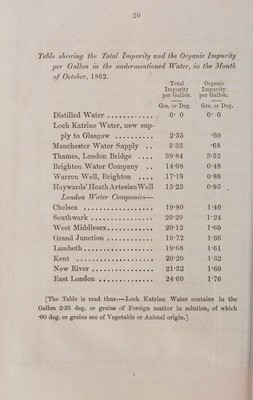
![in the form of minute floating shreds or particles. In both states, viz., the soluble and the insoluble states, the Iron is in combination with organic matter (partly as a Crenate and a Apocrenate of Iron), and as but little Iron is thrown down from the filtered water by the act of ebullition, I am induced to believe that the Iron is not] held in solution by Carbonic Acid Gas. The insoluble floating matter precisely resembles, and is doubtless similar in composition to, the ochraceous looking flocculent matter so frequently to be observed in most superficial chalybeate'springs. It amounts to O'54 in the gallon.” The quantity*1 of the water continues apparently to be unlimited. When the pumps are not in operation the well overflows at the rate of 100,000 gallons per day. The following Table, compiledfrom the Registrar-General’s Table ghew. Weekly Returns, shows the comparative purity of the Hay- p1?ativeC°m' wards’ Heath Well as compared with the London water. In Haywards^'J composition it is very similar to the well sunk at the Warren ea 1 e Farm bv the Directors and Guardians of the Parish of */ Brighton :— i * “ The necessity of having a plentiful supply of water, prevented the opening of the Asylum as soon as otherwise it might have been. An Artesian well, which had been sunk to the depth of 217 feet, required longer time to complete, owing to the extreme hardness of the strata, than had been anticipated.”—Sussex County Lunatic Asylum, First Annual Reports, 1859, [ Table shewing](https://iiif.wellcomecollection.org/image/b30319122_0027.jp2/full/800%2C/0/default.jpg)