The animals of Australia : mammals, reptiles and amphibians / by A.H.S. Lucas ; assisted by W.H. Dudley Le Souëf.
- Arthur Henry Shakespeare Lucas
- Date:
- 1909
Licence: In copyright
Credit: The animals of Australia : mammals, reptiles and amphibians / by A.H.S. Lucas ; assisted by W.H. Dudley Le Souëf. Source: Wellcome Collection.
272/348 page 256
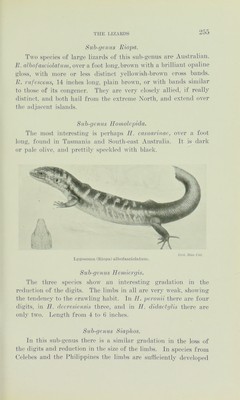
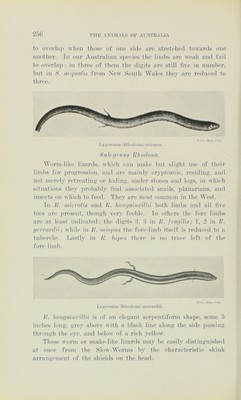
![25G to overlap wiieii those of one side are stretched towards one another. In onr Anslridian species tlie linilis are weak and fail to overlap; in tliree of them the digits are still five in numher. hut in N. a<(jKalis from New South Wales they are reduced to three. Jjygosoina (Hhodoim) niio])us. Jirif. Mus. ('<it. S u b-gc II us Hh odoiia. Worm-like lizards, which can make l)ut slight use of their limlis for ])rogression. and are mainly cryptozoic, residing, and not merely retreating or hiding, under stones and logs, in which situations they prolialily find associated snails, planarians, and insects on wliich to feed. They are most common in the W^est. • In //. iiiicroiis and A'. hougaiiivUUi lioth limbs and all five toes are jiresent, though very feelile. In others the fore limlis are at least indicated; the digits G. 8 in lx. fragilis: 1, 2 in R. gcrrardli: while in R. iiiiopus the fore-limb itself is reduced to a tnheiade. Lastly in R. bipes there is no trai-e left of the fore limb. R. bougaiiivilJii is of an elegant serpentiform shape, some 5 inclies long, grey above with a black line along the side passing through the eye. and lielow of a rich yellow. These worm or snake-like lizards may be easily distinguished at once from tlie Slow-Wmrms by the characteristic skink arrangement of the shields on the head.](https://iiif.wellcomecollection.org/image/b28108759_0272.jp2/full/800%2C/0/default.jpg)


 No text description is available for this image
 No text description is available for this image
 No text description is available for this image