The animals of Australia : mammals, reptiles and amphibians / by A.H.S. Lucas ; assisted by W.H. Dudley Le Souëf.
- Arthur Henry Shakespeare Lucas
- Date:
- 1909
Licence: In copyright
Credit: The animals of Australia : mammals, reptiles and amphibians / by A.H.S. Lucas ; assisted by W.H. Dudley Le Souëf. Source: Wellcome Collection.
276/348 page 260
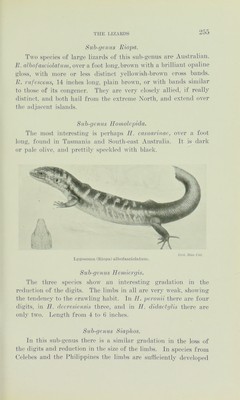
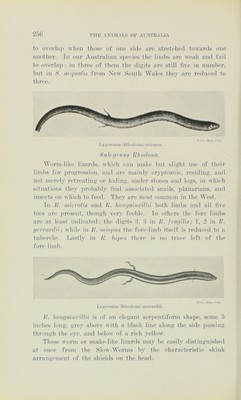
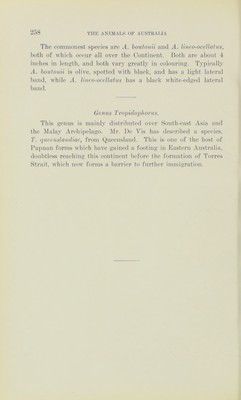
![2G0 dilatation, and by their varying phases produce quite extra- ordinary changes in the colouring of the frog. Tliis is especially notalile in the breeding season. The eyes are of full size, on the ordinary vertebrate type. The pupil is a slit, horizontal or vertical in the different genera. There are two eyelids; the upper is large and pigmented, and lias little iiower of movement; the lower is thin and semi- transparent, and resembles the nictitating membrane of a bird ratlu'r than an ordinary eyelid. This lid is drawn up to close the eye. There is always an internal ear, but while in most of our frogs the tympanum is plainly visible on the side of the head just in front of the fore-limb, in some the position of the ear is indicated only by a slight depression. There is no external ear. The tongue is soft and fleshy. It is attached to the floor of the month in front, with the tip pointing to tlie fauces when not in use. This attachment, of course, gives a greater range and reach to the tongue when darted out as a prehensile organ to seize insects, (fustatory organs are present. The skull consists of a narrow linear cranial portion, with wide semi-circular jaw arches. In accordance with the lack of flexibility in the joint, the skull is articulated with the atlas vertebra by two occipital condylcf;, as in the Mammalia, and in marked distinction from the Birds and Reptiles, in which the occipital condyle is single. The teeth are small with ])ointed crowns. Their distribution varies with the species, but the only bones to which they are found attached are the premaxillay the maxillaL and the vomers. They are of service in retaining the prey, and the tips are recurved for this purpose. The vertebral column consists of an anterior half, in which the atlas, axis, and some seven other vertebive form a jointed .axis ending in the largest of the vertebiw, the sacrum, to the transverse jirocesses (diapophyses) of which the long narrow ilia of the judvic girdle are attached in front; and of a posterior half formed of a long narrow unjointed urostyle, which forms the skeleton of a sort of internal tail. In the sitting attitude of the frog, the hump which is so noticeable is not due to any arching of the backbone, Imt the front up slope of the hump is supported by the ascending spinal column, while the back down- slope is sui)ported by the descending iliac bones. There are no ribs enclosing the thoracic cavity.](https://iiif.wellcomecollection.org/image/b28108759_0276.jp2/full/800%2C/0/default.jpg)


 No text description is available for this image
 No text description is available for this image
 No text description is available for this image