The animals of Australia : mammals, reptiles and amphibians / by A.H.S. Lucas ; assisted by W.H. Dudley Le Souëf.
- Arthur Henry Shakespeare Lucas
- Date:
- 1909
Licence: In copyright
Credit: The animals of Australia : mammals, reptiles and amphibians / by A.H.S. Lucas ; assisted by W.H. Dudley Le Souëf. Source: Wellcome Collection.
298/348 page 282
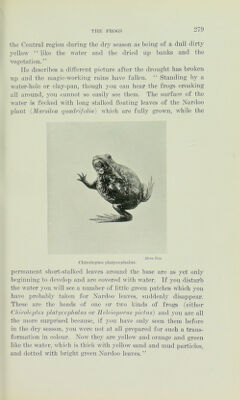
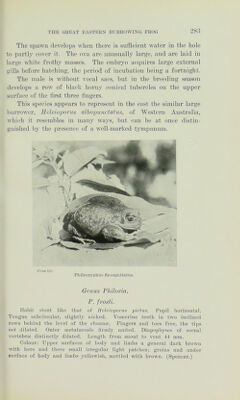
![('hirohpfcs pJalycephalus it takes iq) an internal supply of water and assnnies a giobnlar shape. Tt has similarly the power of intiatin*];' itself into a ball with air. Mr. Fletcher has liad specimens from the table-land of New South Wales, but does not record it from tlie coastal region. Genus l/ltilocri/pli us. The Great Eastern Burrowing Frog. r. iiavoguftaius. A reimirkably large frog, which has only been met with, and that •sparingly, in the neighbourhood of Sydney and in the Blue Mountains. It is of stout build, more like a toad than a frog, !)0 mm. long from snout to vent. The limbs are short and stout. The skin is glandular warty above and smooth over the greater part of the under surface. The u])])er surfaces are ]mrplish-grey or bluish-black, the sides of the body and the region about the vent much spotted with yellow, a short yellow line above the angle of the mouth below the tym])anum, the throat dusky and the belly white. iiie animal burrows, or hides in ready-made holes. Occasion- ally one conies across one in digging or forking the garden. AVhen handled, and especially if tickled or scratched on the back, it distends itself in a remarkable way. becoming nearly as round as a ball, and sometimes on such occasions it cries in the weirdest fashion just like an infant. ]\lr. Fletcher remarks that this habit of inflating themselves football-wise is common to this and other burrowing forms, Lininochinasfcs dorsalis, Cltiroleptes plaiycephalus and iSotaden benneffii, and he suggests that while it may be of some protective value as a deterrent to their enemies, it may be possibly of prime importance in their burrowing operations. Tie says that several times when keeping these frogs in a vivarium with several inches of loose earth on the bottom they entirely disappeared, leaving the surface so level and apparently undisturbed that without actually unearthing them their exact whereabouts was not evident. They are undoubtedly adepts at burrowing, even in stitf soil, and it may be that they prop up or keep open in this way a section of the burrow while they are working below with their short blunt partly-webbed toes at the next section.](https://iiif.wellcomecollection.org/image/b28108759_0298.jp2/full/800%2C/0/default.jpg)
 No text description is available for this image
 No text description is available for this image
 No text description is available for this image