The animals of Australia : mammals, reptiles and amphibians / by A.H.S. Lucas ; assisted by W.H. Dudley Le Souëf.
- Arthur Henry Shakespeare Lucas
- Date:
- 1909
Licence: In copyright
Credit: The animals of Australia : mammals, reptiles and amphibians / by A.H.S. Lucas ; assisted by W.H. Dudley Le Souëf. Source: Wellcome Collection.
316/348 page 300
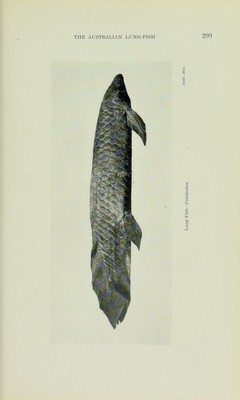
![800 by stroiiu' trausv(‘rse sapla. about 80 on each sid(‘, and the l)ottoin of each compartnient is subdivided into cells by a network of thin ])artitions. 'The blood vessels, while in the main resembling' in arranuement those of the Sharks, show in associa- tion with the presence of a hm»’ some marked resend)lances to those of the Am])hibia. and esi)ecially of the tadpole of the Fro^ during' the stage in which both the gills and the lungs are used in respiration. In fact, so far as respiration is concerned, (^eratodus is practically a gigantic tadi)ole. Ceratodus is now confined to the .Mary and Burnett Fivers of Queensland. It never leaves the water voluntarily. In fact, if removed from tlu' water, it remains passive, and dies in a few hours. It can. however, if kei>t moist in wet water-weed or moss, live for a long time, and bears transportation over con- siderable distances. Mr. 1). ()’C\)unor has been verv successful in conveying the fish in this way, which serves well for trans})ort in Australia. On one occasion the fish were out of water for 38 horn's and suffered no harm. He was also successful in carrying specimens to London, where they arrived in a healthy state at the end of their long .iourney. In this case he used a tank, and fed the animals on water-weed, especially Valisneria. It is hardy and has been acclimatised in Brisbane, while hsh which reached London lived for several years in the Zoological Gardens. It is in general sluggish, “too lazy to get out of the way when about to be handled.” and “resting for hours on the bottom.” It will feed both by night and by day. but seems to be more active at night. Information on the habits of Ceredodus has been collected by several observers, Ramsay, Illidge, Spencer, Semon, and O’Connor, and an excellent summary of these has been given in the Proceedings of the Zoological Society of London by Dr. Bashford Green. He adds most valuable records of his obser- vations made on the animals during captivity in the tanks of the Zoological Gardens. He writes that the acpiatic respiration (l)y gills) is slow and regular. The opercular cavity fills and empties twelve times a minute ordinarily, but more rapidly if the animal is excited. The mouth is scarcely opened, the water being drawn through the dilat(id nostrils. At intervals of 40 to 60 minutes the fish](https://iiif.wellcomecollection.org/image/b28108759_0316.jp2/full/800%2C/0/default.jpg)
 No text description is available for this image
 No text description is available for this image
 No text description is available for this image