The eye in health and disease : being a series of articles on the anatomy and physiology of the human eye, and its surgical and medical treatment / by B. Joy Jeffries.
- Benjamin Joy Jeffries
- Date:
- 1871
Licence: Public Domain Mark
Credit: The eye in health and disease : being a series of articles on the anatomy and physiology of the human eye, and its surgical and medical treatment / by B. Joy Jeffries. Source: Wellcome Collection.
Provider: This material has been provided by the Francis A. Countway Library of Medicine, through the Medical Heritage Library. The original may be consulted at the Francis A. Countway Library of Medicine, Harvard Medical School.
35/132 page 29
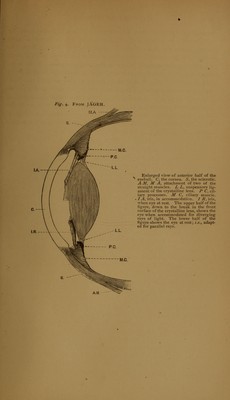
![PHYSIOLOGY OF THE EYE. ]VTOW let us here pause a minute and consider the aggregate of *- ^ what has been so far described. The limpid aqueous humor contained within the perfectly transparent convex cornea, gives us a plano-convex lens. The iris lined with black pigment, and pierced with an opening, capable of alteration in size, represents an optical diaphragm. The crystalline, a double convex lens of greater den- sity than the aqueous, behind the iris, completes the necessary optical apparatus to form a camera obscura, which the eye in reality is. A camera obscura is, as you know, an apparatus formed of a dark chamber, having an aperture in one of its walls, where is fitted a convex lens, and within the chamber is some appropriate surface on which will be painted, in inverted position, a perfect little picture of all outside objects within a certain range. Optically we may regard the cornea, aqueous humor, and lens, as one double convex lens. But where is the apparatus or membrane corresponding to the recip- ient surface of the camera obscura? It is the retina, R, Fig. 3, the true sentient portion of the organ of vision. It is called the third coat, and lies in contact with the limiting or hyaloid membrane we described, externally being against the pigment layer covering the dark choroid. It lines the interior of the globe up to the posterior end of the ciliary processes. In natural condition it is almost per- fectly transparent, and will therefore allow the light coming into the pupil to pass through it to the pigment layer. The optic nerve, N, Fig. 3, as it comes from the brain through the cranium into the orbit, and so to the eyeball, is a compact bun- dle of an innumerable number of nerve fibres. The mass of them together, where they enter the eyeball, form a round spot, called the optic papilla; from here the fibres pass off colorless, on the inner surface of the retina. More of them go towards the central point of the back of the eye, where the line V A, Fig. 3, strikes the retina, and where vision is best, and fewer and fewer towards the peripheric parts, as far forwards as the retina extends. No greater mistake has been made than that of regarding the re- tina as a sort of expansion or spreading out of the fibres of the optic nerve. In reality the fibres of this nerve are merely the conductors from the retina to the brain of certain sensations, as the telegraph wires transmit thought. The optic nerve fibres do not receive the impression of light, but simply transmit it to the brain. If they did,](https://iiif.wellcomecollection.org/image/b21060885_0035.jp2/full/800%2C/0/default.jpg)

 No text description is available for this image
 No text description is available for this image
 No text description is available for this image