National Commission for the Protection of Human Subjects of Biomedical and Behavioral Research : [transcript of the third meeting], February 14-15, 1975 ... Bethesda, Maryland.
- United States. National Commission for the Protection of Human Subjects of Biomedical and Behavioral Research
- Date:
- [1975]
Licence: Public Domain Mark
Credit: National Commission for the Protection of Human Subjects of Biomedical and Behavioral Research : [transcript of the third meeting], February 14-15, 1975 ... Bethesda, Maryland. Source: Wellcome Collection.
68/566 page 63
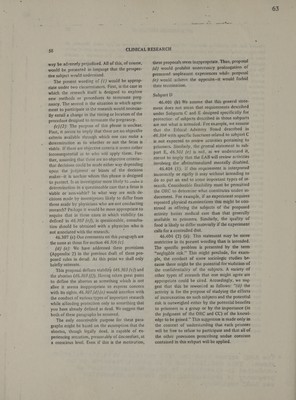
![way be adversely prejudiced. All of this, of course, would be presented in language that the prospec- tive subject would understand. The present wording of (/) would be approp- riate under two circumstances. First, is the case in which the research itself is designed to explore new methods or procedures to terminate preg- nancy. The second is the situation in which agree- ment to participate in the research would necessar- ily entail a change in the timing or location of the procedure designed to terminate the pregnancy. (c} (2): The purpose of this phrase is unclear. First, it seems to imply that there are no objective determination as to whether or not the fetus is viable. If there are objective criteria it seems rather inconsequential as to who will apply them. Fur- ther, assuming that there are no objective criteria— that decisions could be made either way depending upon the judgment or biases of the decision maker—it is unclear whom this phrase is designed to protect. Is an investigator more likely to snake a determination in a questionable case that a fetus is viable or non-viable? In what way are such de- cisions made by investigators likely to differ from those made by physicians who are not conducting research? Perhaps it would be more appropriate to require that in those cases in which viability (as defined in 46.303 (e)), is questionable, consulta- tion should be obtained with a physician who is not associated with the research. : 46.307 (c) Our comments on this paragraph are the same as those for section 46.306 (c). (d) (e): We have addressed these provisions (Appendix 2) in the previous draft of these pro- posed rules in detail. At this point we shall only briefly reiterate. . This proposai defines viability (46.303 (e)) and the abortus (46.303 (f)). Having taken great pains to define the abortus as something which is not alive it seems inappropriate to express concern with its rights. 46.307 (d) (e) would interfere with the conduct of various types of important research while affording protection only to something that you have already defined as dead. We suggest that both of these paragraplis be removed. The only conceivable purpose for these para- graphs might be based on the assumption that the abortus, though legally dead, is capable of ex- periencing sensation, presumably of discomfort, at a conscious level. Even if this is the motivation, these proposals seem inappropriate. Thus, proposal (d) would prohibit unnecessary prolongation of presumed unpleasant experiences while proposal fe) would achieve the opposite-it would forbid their termination. Subpart D 46.401 (b) We assume that this general state- ment does not mean that requirements described under Subparts C and E designed specifically for protectior of subjects described in those subparts are not what is intended. For example, we assume that the Ethical Advisory Board described in 46.304 with specific functions related to subpart C is not expected to review activities pertaining to prisoners. Similarly, the general statement in sub- part E, 46.50] (c} is not, as we understand it, meant to imply that the EAB will review activities involving the irlstitutionalized mentally disabled. 46.404 (1): If this requirement is interpreted incorrectly or rigidly it may without intending to do so put an end to some important types of re- search. Considerable flexibility must be permitted the ORC to determine what constitutes undve in- ducement. For example, if an experiment requires repeated physical examinations this might be con- strued as offering the subjects of the proposed activity better medical care than that generally available to prisoners. Similarly, the quality of food is likely to differ materially if the experiment calls for a controlled diet. 46.404 (2) (ii): This staternent may be more restrictive in its present wording than is intended. The specific problem is presented by the term “negligible risk.” This might preclude, for exam- ple, the conduct of some sociologic studies be- cause there might be the potential for violation of the confidentiality of the subjects. A variety of other types of research that one might agree are appropriate could be cited. Accordingly, we sug- gest that this be reworded as follows: “/ii) the activity is for the purpose of studying the effects of incarceration on such subjects and the potential risk is outweighed either by the potential benefits to prisoners as a group or by the importance (in the judgment of the ORC and CC) of the knowl- edge to be gained.” This suggestion is made only in the context of understanding that each prisoner wili be free to refuse to participate and that all of the other provisions proscribing undue coercion contained in this subpart will be applied.](https://iiif.wellcomecollection.org/image/b32221496_0068.jp2/full/800%2C/0/default.jpg)
 No text description is available for this image
 No text description is available for this image
 No text description is available for this image