Selected genetic papers of J.B.S. Haldane / edited with an introduction by Krishna R. Dronamraju.
- J.B.S. Haldane
- Date:
- 1990
Licence: Attribution-NonCommercial 4.0 International (CC BY-NC 4.0)
Credit: Selected genetic papers of J.B.S. Haldane / edited with an introduction by Krishna R. Dronamraju. Source: Wellcome Collection.
550/580 (page 522)
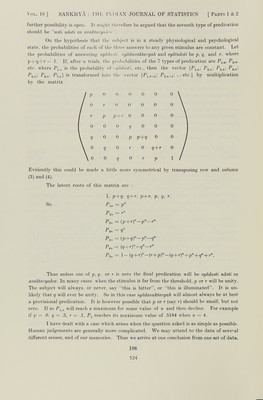
![Vol. 18] SANKHYÄ : Tili: INDIAN JOURNAL OF STATISTICS [ Parts 1 & 2 by the table 0, 3, 1, 4, 2. For ехаюрк- if x = 4, 3a: = 2. Of course many other functions are identical with it. For exani|)k' :\.r' = x^-\-2x^ = 3x. A function which assumes all the admissible values unequivocally is called biunivocaP, and it is easy to show that there are m\ biunivocal functions. However some functions are univocal, but their inverses are not. In this case some residues do not occur in the table, while others occur more than once. For example the table of 3a.'^+l (mod.5) is 1,4, 3, 3, 4. The number of univocal functions is m', since each' place in the table c an be filled in m ways. If a function is not univocal, but its inverse is univocal, we obtain a table such as that for x^, namely 0, 1 or 4, çj, 51, 1 or 4. Here I introduce the symbol Çï, for avakta, for an undefined number. There is no number whose square (mod. 5) is 2 or 3. 51 may occur in a table as an alternative to a number. For example the function is never integral when X is a residue other than zero. Nor is it integral for most values of x which are avakta, such as -y/2. But it is integral for such numbers as log 2. Hence the table of is 1 ; 51; 51; 51; and 0, 1, 2, 3, 4, or 51. The last place in the table corresponds to a; = 51. Similarly if луе consider the function у defined by y^—y^ = then we find the table 0 or 1, 5Г, 2 or 51, 2 or 5(, 51, 3 or 4 or 5f. For Avhen x = 2 or 3, 4 = 0, so i/ = 2 or 2±-\/2, the latter two roots being con¬ gruent with i(—1±V—7). These quantities are inexpressible (avakta) modulo 5. And when X = 41, x'^ = 2, 3, or 5Г, so у may be 3 or 4, as well as 5f. Thus for a fuU enumeration of functions modulo m we need a table with m-\-\ places corresponding to the residues 0, 1, 2 ..., m—1, and 51. In each place we can set one, or any number, of these symbols, but we must set at least one. So each place can be filled in ways, for each of the m+1 symbols can be present or absent, except that all cannot be absent. Thus the total number of functions modulo m is (2'^^ — for example 62, 523, 502, 209 if »I = 5, as compared with only 120 biunivocal functions, and 3125 univocal. Now consider the simplest of the finite arithmetics, namely arithmetic modulo 2. There are only two elements, 0 and 1. Electronic calculators are based on this arithmetic. These machines are so designed that each unit, as the result of any instruction, wiU be active (1) or inactive (0) at any given moment. And it is possible, in principle, to predict whether it will be active or inactive. That is to say ambiguity is avoided, and the machine is designed to operate in terms of univocal functions. Nevertheless it is possible to provide such a machine with an instruction to which it cannot give a definite answer. It is said that some such machines, when given an instruction equivalent to one of the paradoxes of Principia Mathematica, come to no conclusion, but print 101010...indefinitely. Clearly a machine could be designed to prmt 51 in such a case. It is obviously possible to design a machine which would print 0 or 1 in response to the instruction x^—x = 0. . A machme with the further refinement suggested above would respond 0, l,or 5l to the instruction (x'^—x) cos ж = 0 (mod 2). Such a machine could give any of 7 responses, namely : 0, 1, 5Г, 0 or 1, 0 or 5Î, 1 or 5i, 0 or 1 or 51. These are the saptabhanghlnaya with the ommission of the syllable syád. I I have deliberately chosen a word with the same root (Latin vox 196 522 = Sanskrit vak) as avakta.](https://iiif.wellcomecollection.org/image/b18033027_0551.JP2/full/800%2C/0/default.jpg)