The natural history of digestion : by A. Lockhart Gillespie / Illustrated by figures, diagrams, and charts.
- Andrew Lockhart Gillespie
- Date:
- 1898
Licence: Public Domain Mark
Credit: The natural history of digestion : by A. Lockhart Gillespie / Illustrated by figures, diagrams, and charts. Source: Wellcome Collection.
Provider: This material has been provided by the Augustus C. Long Health Sciences Library at Columbia University and Columbia University Libraries/Information Services, through the Medical Heritage Library. The original may be consulted at the the Augustus C. Long Health Sciences Library at Columbia University and Columbia University.
441/498 (page 391)
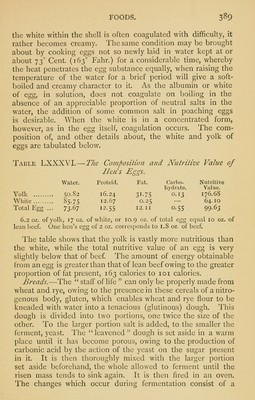
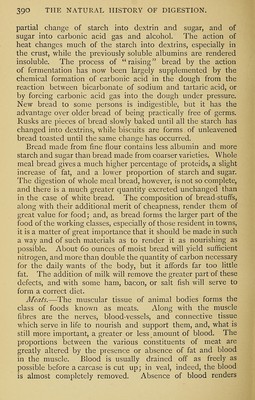
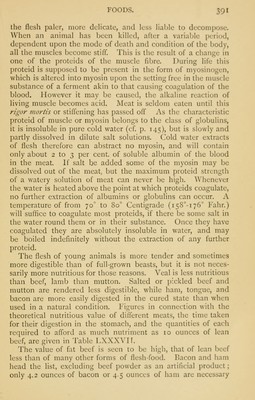
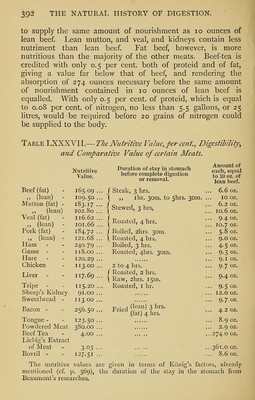
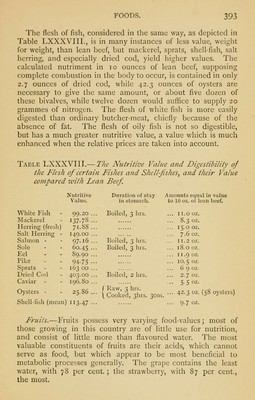
![the flesh paler, mure delicate, and less liable to decom] When an animal has been killed, after a variable period, dependent upon the mode of death and condition of the body, all the muscles become stiff. This is the result of a change in one of the proteids of the muscle fibre. During life this proteid is supposed to be present in the form of myosin which is altered into myosin upon the setting free in the muscle substance of a ferment akin to that causing coagulation of the blood. However it may be caused, the alkaline reaction of living muscle becomes acid. Meat is seldom eaten until this rigor mortis or stiffening has passed off As the characteristic proteid of muscle or myosin belongs to the class of globulins, it is insoluble in pure cold water (cf. p. 145), but is slowly and partly dissolved in dilute salt solutions. Cold water extracts of flesh therefore can abstract no myosin, and will contain only about 2 to 3 per cent, of soluble albumin of the blood in the meat. If salt be added some of the myosin may be dissolved out of the meat, but the maximum proteid strength of a watery solution of meat can never be high. Whenever the water is heated above the point at which proteids coagulate, no further extraction of albumins or globulins can occur. A temperature of from 70° to 8o° Centigrade (i58°-i76° Fahr.) will suffice to coagulate most proteids, if there be some salt in the water round them or in their substance. Once they have coagulated they are absolutely insoluble in water, and may be boiled indefinitely without the extraction of any further proteid. The flesh of young animals is more tender and sometimes more digestible than of full-grown beasts, but it is not neces- sarily more nutritious for those reasons. Veal is less nutritious than beef, lamb than mutton. Salted or pickled beef and mutton are rendered less digestible, while ham, tongue, and bacon are more easily digested in the cured state than when used in a natural condition. Figures in connection with the theoretical nutritious value of different meats, the time taken for their digestion in the stomach, and the quantities of each required to afford as much nutriment as 10 ounces of lean beef, are given in Table LXXXVIT. The value of fat beef is seen to be high, that of lean beef less than of many other forms of flesh-food, bacon and ham head the list, excluding beef powder as an artificial product ; only 4.2 ounces of bacon or 4.5 ounces of ham are nea](https://iiif.wellcomecollection.org/image/b21221145_0441.jp2/full/800%2C/0/default.jpg)