Oriental customs: or an illustration of the sacred Scriptures, by an explanatory application of the customs and manners of the Eastern nations, and especially the Jews. Therein alluded to, together with observations on many difficult and obscure texts, collected from the most celebrated travellers, and the most eminent critics / by Samuel Burder.
- Samuel Burder
- Date:
- 1802
Licence: Public Domain Mark
Credit: Oriental customs: or an illustration of the sacred Scriptures, by an explanatory application of the customs and manners of the Eastern nations, and especially the Jews. Therein alluded to, together with observations on many difficult and obscure texts, collected from the most celebrated travellers, and the most eminent critics / by Samuel Burder. Source: Wellcome Collection.
384/448 (page 356)
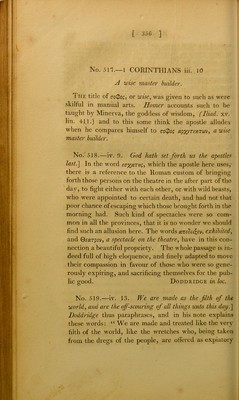
![No. 517.—1 CORINTHIANS iii. 10 A wise master builder. I he title of aoCjPog, or wise, was given to such as were skilful in manual arts. Homer accounts such to be taught by Minerva, the goddess of wisdom, (Iliad, xv. lin. 411.) and to this some think the apostle alludes when he compares himself to aoQog up%iT£XTuv, a wise master builder. No. 518.—iv. 9. God hath set forth us the apostles last.] In the word Eaxarsg, rvhich the apostle here uses, there is a reference to the Roman custom of bringing forth those persons on the theatre in the after part of the day, to fight either with each other, or with wild beasts, who were appointed to certain death, and had not that poor chance of escaping which those brought forth in the morning had. Such kind of spectacles were so com- mon in all the provinces, that it is no wonder we should find such an allusion here. The words uTcehei^ev, exhibited, and Qecnpov, a spectacle on the theatre, have in this con- nection a beautiful propriety. The whole passage is in- deed full of high eloquence, and finely adapted to move their compassion in favour of those who were so gene- rously expiring, and sacrificing themselves for the pub- lic good. Doddridge in loc. No. 519.—iv. 13. We are made as the filth of the world, and are the off-scouring of all things unto this day.] Doddridge thus paraphrases, and in his note explains these words: “ We are made and treated like the very filth of the world, like the wretches who, being taken from the dregs of the people, are offered as expiatory](https://iiif.wellcomecollection.org/image/b22040900_0386.jp2/full/800%2C/0/default.jpg)