Oriental customs: or an illustration of the sacred Scriptures, by an explanatory application of the customs and manners of the Eastern nations, and especially the Jews. Therein alluded to, together with observations on many difficult and obscure texts, collected from the most celebrated travellers, and the most eminent critics / by Samuel Burder.
- Samuel Burder
- Date:
- 1802
Licence: Public Domain Mark
Credit: Oriental customs: or an illustration of the sacred Scriptures, by an explanatory application of the customs and manners of the Eastern nations, and especially the Jews. Therein alluded to, together with observations on many difficult and obscure texts, collected from the most celebrated travellers, and the most eminent critics / by Samuel Burder. Source: Wellcome Collection.
396/448 (page 368)
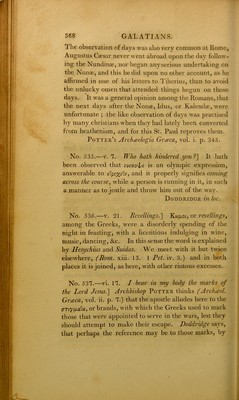
![The observation of days was also very common at Rome, Augustus Caesar never went abroad upon the day follow- ing theNundinae, nor began anyserious undertaking on the Nonae, and this he did upon no other account, as he affirmed in one of his letters to Tiberius, than to avoid the unlucky omen that attended things begun on those days. It was a general opinion among the Romans, that the next days after the Nonae, Idus, or Kalendae, were unfortunate ; the like observation of days was practised by many Christians when they had lately been converted from heathenism, and for this St. Paul reproves them. Potter’s Archaologia Greeca, vol. i. p. 345. t No. 535.—v. 7. Who hath hindered you f] It hath been observed that is an Olympic expression, answerable to e]and it properly signifies coming across the course, while a person is running in it, in such a manner as to jostle and throw him out of the way. Doddridge in loc. No. 536.—v. 21. Retellings.] Kufxoi, or retellings, among the Greeks, were a disorderly spending of the night in feasting, with a licentious indulging in wine, music, dancing, &c. In this sense the word is explained by Hesy chins and Suidas. We meet with it but twice elsewhere, (Rom. xiii. 13. 1 Pet. iv. 3.) and in both places it is joined, as here, with other riotous excesses. No. 537.—vi. 17. I bear in my body the marks of the Lord Jesus.] Archbishop Potter thinks (Archteol. Greeca, vol. ii. p. 7.) that the apostle alludes here to the cTiyfxcilci, or brands, with which the Greeks used to mark those that were appointed to serve in the wars, lest they should attempt to make their escape. Doddridge says, that perhaps the reference may be to those marks, by](https://iiif.wellcomecollection.org/image/b22040900_0398.jp2/full/800%2C/0/default.jpg)