Oriental customs: or an illustration of the sacred Scriptures, by an explanatory application of the customs and manners of the Eastern nations, and especially the Jews. Therein alluded to, together with observations on many difficult and obscure texts, collected from the most celebrated travellers, and the most eminent critics / by Samuel Burder.
- Samuel Burder
- Date:
- 1802
Licence: Public Domain Mark
Credit: Oriental customs: or an illustration of the sacred Scriptures, by an explanatory application of the customs and manners of the Eastern nations, and especially the Jews. Therein alluded to, together with observations on many difficult and obscure texts, collected from the most celebrated travellers, and the most eminent critics / by Samuel Burder. Source: Wellcome Collection.
40/448 page 12
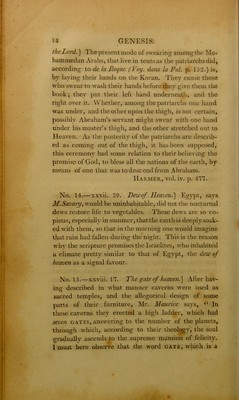
![cities, the chief of which was Sodom, were once de- stroyed and swallowed up by earthquakes, fire, and an inundation of boiling sulphureous water. (Strab. Geog. lib. xvi.) Maundrell visited the lake Asphaltis in the year 1697, and makes the following observations upon it. “ Being desirous to see the remains, (if there were any) of those cities anciently situate in this place, and made so dreadful an example of the divine vengeance, I diligently surveyed the waters, as far as my eye could reach; but neither could I discern any heaps of ruins, nor any smoke ascending above the surface of the water, as is usually described in the writings and maps of geographers. But yet I must not omit, what was con- fidently attested to me by the father guardian, and pro- curator of Jerusalem, both men in years, and seemingly not destitute either of sense or probity, that they had once actually seen one of these ruins; that it was so near the shore, and the waters so shallow at that time, that they went to it, and found there several pillars, and other fragments of buildings. The cause of our being deprived of this sight was, I suppose, the height of the water.” (Travels, p. 85.) The account which The- veyiot gives is much to the same purpose. <( There is no sort of fish in this sea, by reason of the extraordinary saltness of it; which burns like fire, when one tastes of it. And when the fish of the water Jordan come down so low, they return back again against the stream; and such as are carried into it by the current of the water immediately die. The land within three leagues round it is not cultivated, but is white, and mingled with salt and ashes. In short, we must think that there is a heavy curse of God upon that place, seeing it -was here- tofore so pleasant a country.” (Travels, vol. i. p. 194). No. 11.—xxi. 23. Swear unto me here by God.] This kind of oath appears not only to have been gene- %](https://iiif.wellcomecollection.org/image/b22040900_0040.jp2/full/800%2C/0/default.jpg)