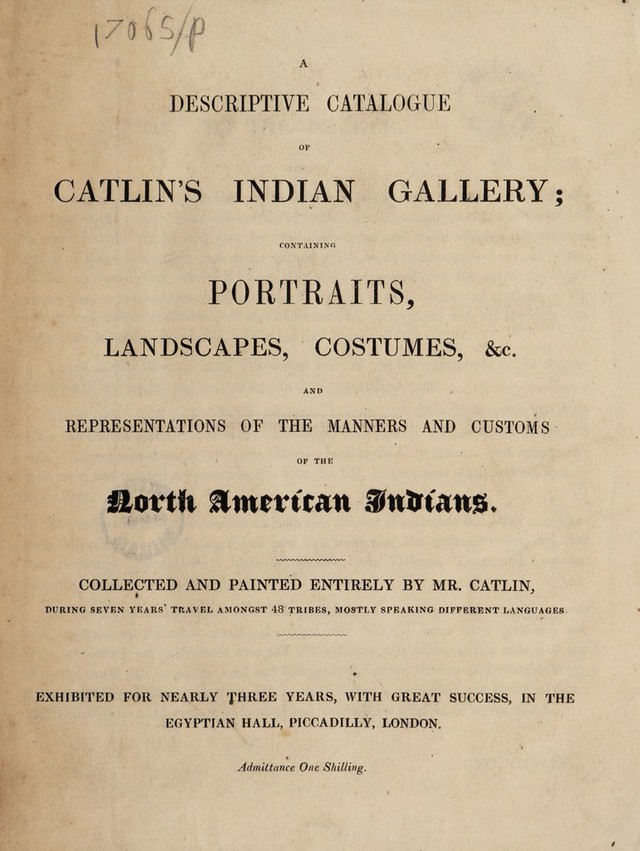
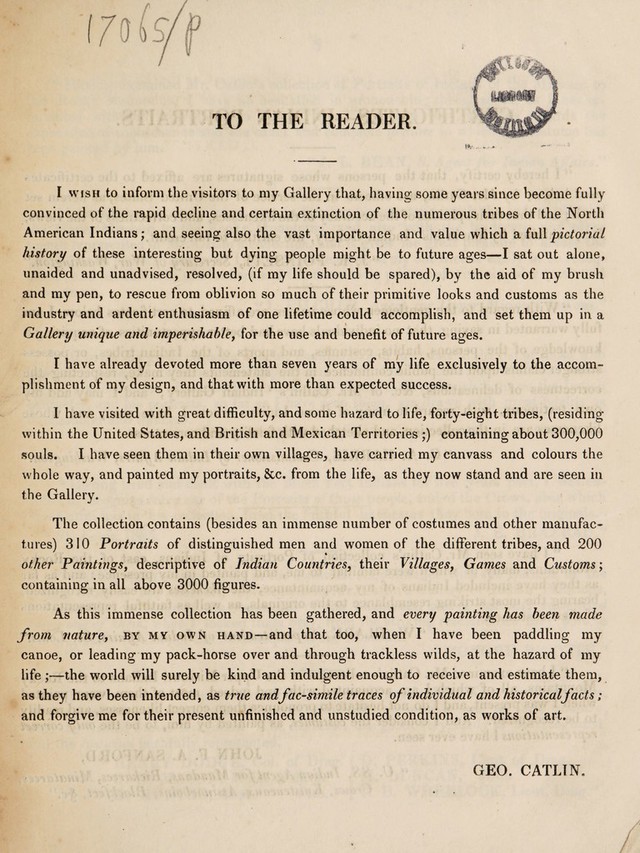
A descriptive catalogue of Catlin's Indian gallery; : containing portraits, landscapes, costumes, &c. And representations of the manners and customs of the North American Indians. / Collected and painted entirely by Mr. Catlin, during seven years' travel amongst 48 tribes, mostly speaking different languages.
- George Catlin
- Date:
- [1842?]
Licence: Public Domain Mark
Credit: A descriptive catalogue of Catlin's Indian gallery; : containing portraits, landscapes, costumes, &c. And representations of the manners and customs of the North American Indians. / Collected and painted entirely by Mr. Catlin, during seven years' travel amongst 48 tribes, mostly speaking different languages. Source: Wellcome Collection.
51/64 page 51
![/ and amusement; after which he walked out to the party about to start off, and advancing to the painter (or Great Medicine, as they called him) with a sarcastic smile on his face, in due form, and with much grace and effect, he carefully withdrew again from his bosom the polished silver medal, and turning the face of it to the painter, said, “Tell my Great Mother that you saw our Great Father, and that we keep his face bright!’’ THE GLOBE AND TRAVELLER. North American Indiajis. — An exhibition has been opened consisting of portraits, landscapes, costumes, im¬ plements of war, articles of commerce, and a variety of curiosities illustrating the manners, habits, and customs of forty-eight different tribes of the North American Indians. The collection, which must prove highly in¬ teresting to all who take an interest in the various modes of life existing among our fellow-creatures in the different states and stages of savage life, or comparative civilization, consists of 310 portraits of distinguished men and women of the different Indian tribes; and ‘200 other paintings de¬ scriptive of Indian countries, villages, sports, and pastimes; the whole of which were painted by Mr. Gatlin, during a residence of eight years among the different tribes. An additional interest is given to the paintings by the various implements used by the natives, such as bows, arrows, tomahawks, and scalping-knives. There are even human scalps which illustrate one of the paintings representing the scalp dance, in which the victors of one tribe exhibit, in one of their war dances, the scalps of another whom they have vanquished. Among the most spirited of the paintings, as works of art, may be enumerated those of the voluntarilv inflicted torments, to which some of the tribes 4/ ' ^ subject themselves, as proofs of their courage; those of the buffalo hunts, buffalo fights, and of the prairies, which are all highly characteristic productions. In speaking of the different items of interest in this exhibition, Mr. Gatlin and the cicerone should not be forgotten, as they amuse the visitors with many of those interesting personal anec¬ dotes which travellers always abound in. THE ATHENiEUM. The Indian Gallery.—This is the collection mentioned heretofore by our American correspondent (No. 609) ; and a most interesting one it is. It contains more than 300 portraits of distinguished Indians, men and women of different tribes, all painted from life, an’d in many instances the identical dress, weapons, &c. are exhibited which they wore when their portraits were taken ; and 200 other paintings, representing Indian customs, games, hunting- scenes, religious ceremonies, dances, villages, and said to contain above 3000 figures: in brief, it is a pictorial history of this interesting and fast perishing race. It includes, too, a series of views of the Indian country ; and w'e have seen nothing more curious than some of the scenes on the Upper Missouri and Mississippi, the general accu¬ racy of which is beyond question. Mr. Gatlin has spent seven years in wandering among the various tribes, for the sole ])urpose of perfecting this collection. As he observes “it has been gathered, and every painting has been] made from nature, by my own liand ; and that, tod, w'hen I have been paddling my canoe or leading my pack- horse over and through trackless Wllds, at the hazard of life. The world will surely be kind and indulgent enough to receive and estimate them as they have been intended, as true and fac-simile traces of individual and historical facts, and forgive me for their present unfinished and unstudied condition as works of art.” The value of this collection is increased by the fact that the red men are fast perishing, and will probably, before many years have passed, be an extinct race. If proof of this were wanting we have it in the facts recorded in the catalogue of the devastation which the smallpox has lately spread among them. Of one tribe, the hospitable and friendly Mandans, as Mr. Gatlin calls them, 2000 in number when he visited them and painted their pictures, 1 living in two permanent villages on the Missouri, 1800 miles above its junction with the Mississippi, not one now exists! In 1837, the smallpox broke out among them, and only thirty-five were left alive ; these w^ere subse¬ quently destroyed by a hostile tribe, which took possession of their villages, and thus, within a few months, the race became extinct—not a human being is believed to have escaped. THE JOHN BULL. Catlhds Indian Gallery.—Mr. Gatlin is an American artist, who, after eight years’ toilsome travel, during which he visited forty-eight tribes of the aborigines of his native land, and traversed many thousands of miles, ap¬ pearing to have crossed in nearly every direction the vast plains which lie between the semi-civilized border and the Rocky Mountains, has succeeded in forming a collection which he truly terms “ unique,” and which ought to be so secured by the purchase of some government or other as to be rendered what he fondly calls it, “ imperishable.” He thus explains the motives which induced bim to undertake this labour:—“Having some years since become fully convinced of the rapid decline and certain extinction of the numerous tribes of the North American Indians, and seeing also the vast importance and value which a full pictorial history of these interesting but dying people might be to future ages, I set out alone, unaided and unadvised, resolved (if my life should be spared), by the aid of my brush and my pen, to rescue from oblivion so much of their primitive looks and customs as the industry and ardent enthusiasm of one lifetime could accomplish, and set them up in a gallery, unique and imperishable, for the use and benefit of future ages.” A proof of the utility of his undertaking is the fact that one of the most singularly interesting tribes which he visited, the Mandans, who numbered 2000 souls in 1834, have been since wholly destroyed, not a remnant of their race left, name, and line, and language utterly extinct. Of the other tribes, too, many thousands have perished since the period of his visit, by the smallpox, which deadly disease sweeps them off by wholesale, by the ardent spirits, still deadlier, introduced among them by](https://iiif.wellcomecollection.org/image/b30390655_0051.jp2/full/800%2C/0/default.jpg)