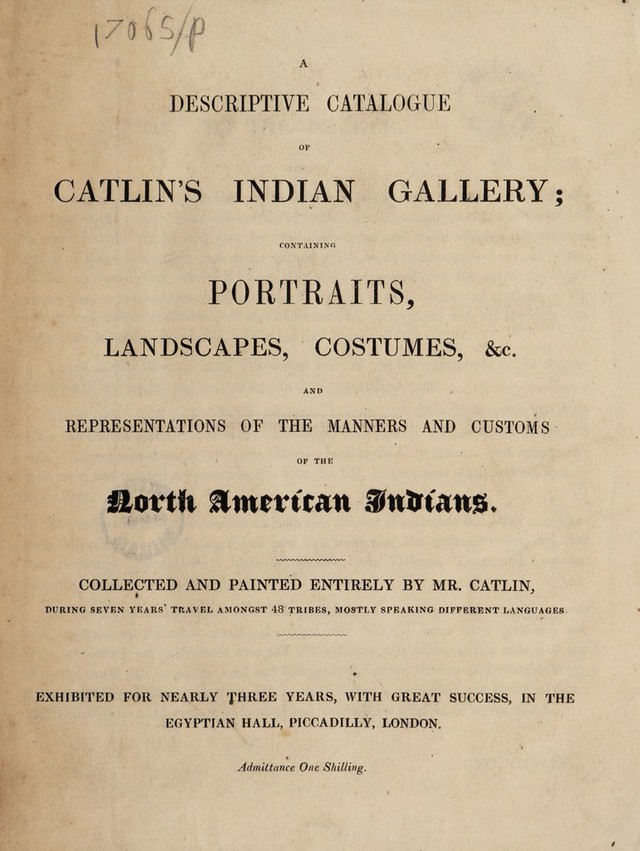
A descriptive catalogue of Catlin's Indian gallery; : containing portraits, landscapes, costumes, &c. And representations of the manners and customs of the North American Indians. / Collected and painted entirely by Mr. Catlin, during seven years' travel amongst 48 tribes, mostly speaking different languages.
- George Catlin
- Date:
- [1842?]
Licence: Public Domain Mark
Credit: A descriptive catalogue of Catlin's Indian gallery; : containing portraits, landscapes, costumes, &c. And representations of the manners and customs of the North American Indians. / Collected and painted entirely by Mr. Catlin, during seven years' travel amongst 48 tribes, mostly speaking different languages. Source: Wellcome Collection.
63/64 page 63
![G3 by ]\Tr. Catliii liimself, at the Egyptian Hall. We wish him all the success to which his candour, no less tlian his talents, fully entitle him.’’ Morioing ClaroHsicIc, London. ‘‘A person might well be startled and frightened at the appearance of two such large volumes as these on only the manners, customs, and condition of the North American Indians, a race of savages now almost extinct. With all this complaint against the immense bulk of a book, more¬ over, on such a subject, we are bound to confess that not only is it the least wearisome of large books that w'e have for a long time seen, but that it is at least one of the most amusing and animating amongst even the condensed pub¬ lications, that for a considerable period have been sub¬ mitted to our perusal and judgment, and we can confidently recommend it to our readers.’’ ^ee24.Sy I>isp2atcli, London. The reflection is almost insupportable to a humane mind, that the indigenous races of America, comprising numerous distinct nations, the original proprietors of that vast conti¬ nent, are probably doomed to entire extermination—a fate wliich has already befallen a large portion of the red tribes. It is still more painful to think that this should be the effect of the spread of the civilized races, who thus become the agents of a wdiolesale destruction of their fellow-men. ' If these melancholy truths were capable of aggravation, it may be found in the dreadful fact that the process of de¬ struction is not left to the slow operation of invisible and insensible causes, but is hastened by expedients de¬ vised for that express end by civilized men, the tribes being stimulated or compelled to the destruction of each other, or provided with the means of destroying themselves. Mr. Catlin, the author of the woi'k which has suggested these observations, has had better opportunities for study¬ ing the character of the North American Indians than most travellers since the early French writers. Mr. Catlin is an American, a native of Wyoming, and the publisher of his own wmrk, at the Egyptian Hall.” Tisiaes, London. One Notice, Three Columns. “ We venture to affirm of Mr. Gatlin’s book, which can be said of very few others, that it is impossible to open it at any page, and not continue its perusal with unmingled satisfaction. It has too the rare quality of being written by a man who says nothing but that which he knows, who describes nothing but that wffiich he has seen. We feel w’hile reading the book, as in the society* of a man of ex¬ traordinary observation, of great talent, of wonderful ac¬ complishments, and, most cordially and earnestly do we recommend this invaluable book to the patronage of the public generally, and to the perusal of our readers in par¬ ticular.” Tlie ^Vorld of* f asfiioii, London. ‘‘The illustrative plates of these volumes are numbering upw’ards of three hundred subjects—landscapes, hunting scenes, Indian ceremonies, and portraits, form a remarkable feature, and possess a permanent interest as graphic re¬ cords. They are outline etchings from the author’s paint¬ ings; and are admirable for the distinct and lively manner in which the characteristics of the scenes and persons are portrayed: what is called ^ style of art wouXA have been impertinent, and might have tended to falsify. Mr. Catlin, in his homely, but spirited manner, seizes upon the most distinguishing points of his subjects by dint of un¬ derstanding their value, and every touch has significance and force: hence the number of details, and the extent of view embraced in these small and slight sketches, hence their animation and reality.’’ SpccfsitoF, London. Five Columns, “Of all the w'orks yet published on the subject of the aboriginal inhabitants of North America, no one, it seems to us, can be compared in the point of accuracy, ‘and ex¬ tent of research with that of Mr. Catlin. In the course of eight years he traversed North America almost from end to end, saw and mixed with forty-eight Indian tribes, composing a large portion of the two millions of red people yet in existence, examined personally into all their pecu¬ liarities, and, finally, accumulated a noble gallery of por¬ traits, and a rich museum of curiosities, calculated to form at once a lasting monument to himself and an invaluable record of Indian persons, manners, and habiliments. Mr. Catlin, combining all the qualities of the traveller, artist, and historian, merits no sparing notice. His two volumes, large octavo, and closely printed, are full of most interesting matter, and contain, besides, not less than four hundred beautiful illustrations, engraved from the original paintings.” Claamfeers’ Jowirit. Two Notices, Four Columns. “ This is a remarkable book, written by an extraordinary man. A work valuable in the highest degree for its novel and curious information about one of the most neglected and least understood branches of the human family. Mr. Catlin, without any pretension to talent in authorship, has yet produced a book which will live as a record wffien the efforts of men of much higher genius have been forgotten. Every one in London has seen Mr. Gatlin’s unique gallery, and his attractive exhibition of living models at the Hall; we cannot too strongly recommend them to our country friends. And here we take our leave of a work over which we have lingered with much pleasure, strongly recommending it to the reader, and hoping its ex¬ tensive sale will amply repay Mr. Catlin for the great outlay he must have incurred,’’ W esf miiisteF Me vie w. Twelve pages, “ Mr. Gatlin’s book is one of the most interesting which we have perused on the subject of the Indians. His pencil has preserved the features of races which, in a few years will have disappeared ; and his faithful and accurate obser¬ vations may be considered as the storehouse from whence future wndters on such topics will extract their most authentic statements.” University Magazine. 15 pages, “ This is altogetner an unujue w'ork! It may be consi¬ dered as a Catalogue Raisomiee of the numerous objects of art and curiosity which Mr. Catlin has collected in the course of his wanderings, and arranged in his Indian Gallery. The narrative of Mr. Gatlin’s personal adven-](https://iiif.wellcomecollection.org/image/b30390655_0063.jp2/full/800%2C/0/default.jpg)