Lhasa and its mysteries : with a record of the expedition of 1903-1904 / by L. Austine Waddell.
- Laurence Waddell
- Date:
- 1906
Licence: In copyright
Credit: Lhasa and its mysteries : with a record of the expedition of 1903-1904 / by L. Austine Waddell. Source: Wellcome Collection.
63/746 page 29
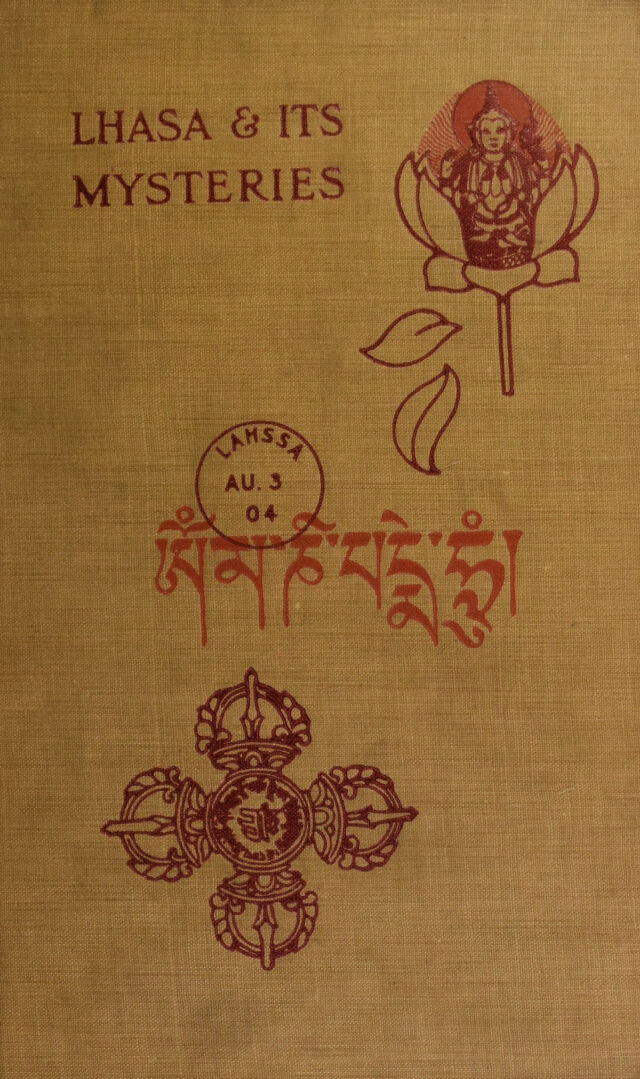
![appear that both he himself and the first abbot were reincarnations of the most powerful and most popular king of Tibet, namely Srongtsan Gampo ; and also that the latter in his turn was an earthly incarnation of the Compassionate Spirit of the Mountains who had given the early Tibetans the magical food which transformed them from monkeys into men. This compassionate spirit was identified with the most popular of all the divinities of the later Buddhists, namely, the “Lord of Mercy” (Avalokita, in Tibetan Chan-ra-zi), who is supposed to be a potential Buddha who relinquished his prospect of becoming a Buddha, and of passing out of the world and existence into the Nirvana1 of extinction, in order to remain in heaven and be available to assist all men on earth who may call upon him to deliver them from earthly danger, to help them to reach paradise and escape hell. All of these three great objects are, the Tibetans believe, easily secured by the mere utterance of the mystic spell of this Lord of Mercy, namely, ‘1 Om ! via-ni pad-me Hung! “Hail! Jewel [Lord of Mercy,] in the Lotus-Flower!” (See the illustration on page 23, for figure of this god within a lotus- flower.) It is not even necessary to utter this spell to secure its efficacy. The mere looking at it in its written form is of equal benefit. Hence the spell is everywhere made to revolve before the eyes, it is twirled in myriads of prayer-wheels, incised on stones in cairns, carved and painted on buildings, as well as uttered by every lip throughout Tibet, Mongolia, Ladak and the Himalayan Buddhist States down to Bhotan, and from Baikal to Western China. In this way, this Dalai Lama converged upon himself the most popular legends and traditions of the Tibetans, and appropriated the most popular of all the mystic spells—“ Om! ma-ni pad-me Hung! On these lines he constructed for himself a super- 1 Strictly Parmirvatia.](https://iiif.wellcomecollection.org/image/b29353531_0063.jp2/full/800%2C/0/default.jpg)

 No text description is available for this image
 No text description is available for this image
 No text description is available for this image