The microtomist's vade-mecum : a handbook of the methods of microscopic anatomy / by Arthur Bolles Lee.
- Arthur Bolles Lee
- Date:
- 1905
Licence: In copyright
Credit: The microtomist's vade-mecum : a handbook of the methods of microscopic anatomy / by Arthur Bolles Lee. Source: Wellcome Collection.
Provider: This material has been provided by The University of Glasgow Library. The original may be consulted at The University of Glasgow Library.
434/572 page 420
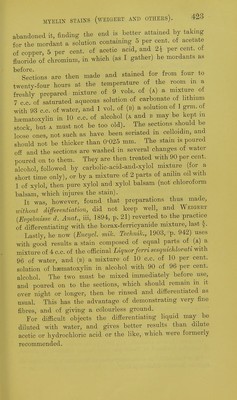
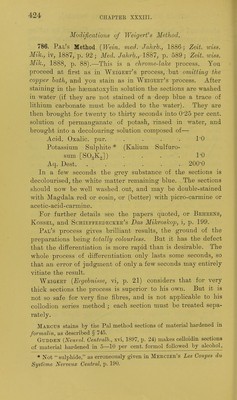
![MYELIN STAINS (WEIGBRT AND OTHERS). 783. Introduction.—The most important of the methods for the study of tracts of medullated nerve-fibres are the hasma- toxylin methods of Weigert. There have been in all three methods of Weigeet—the 1884 method, the 1885 method, and the 1891 method. They depend on the formation, in the tissues, of hsematoxylin • lakes which stain the myelin of nerves in a quite specific way. The 1884 method [Fortschr. d. Med., 1884, pp. 113, 190; Zeit vnss. Mih., 1884, pp. 290, 564), which depends on the formation of a chrome lake, may be considered to be super- seded. Not so the two others, which depend on the formation of a copper lake in addition to the chrome lake. For a critical history of these methods see Weigeet, in Ergehnisse der Anatomie, vi, 1896 (1897), p. 5, and in the art. Nervenfasern, Markscheiden der,'' in Encyd. mik. Technih. 784. Weigbrt's 1885 Method {Fortschr. d. Med., 1885, p 136 • Zeit. wiss Mik., 1885, pp. 399, 484; Ergehnisse der Anatomie, vi, 1896 [1897], p. 10) .-The tissues are to be hardened in bichromate of potash. Weigert takes [Ergelj- nisse, p. 10) a 5 per cent, solution, and if time is an object hardens in a stove. (Other bichromate mixtures will do, e g Miiller's, Kultschizky's, Zenker's; Brlicki's is not to be recommended.) The tissues are ripe for staining when the hardening has been carried to a certain pomt. They are first {Ergehnisse, p. 13) yellow, without differentiation of the grey matter from the white ; these are unripe. Later they show the grey matter light brown, the white matter dark brown (owing to reduction of a part of the bichromate to a chrome oxide in the medullary sheaths) ; these are ''ripe If the hardening be continued all the more highly oxidised chrome will pass into the lower stage of](https://iiif.wellcomecollection.org/image/b21462586_0434.jp2/full/800%2C/0/default.jpg)