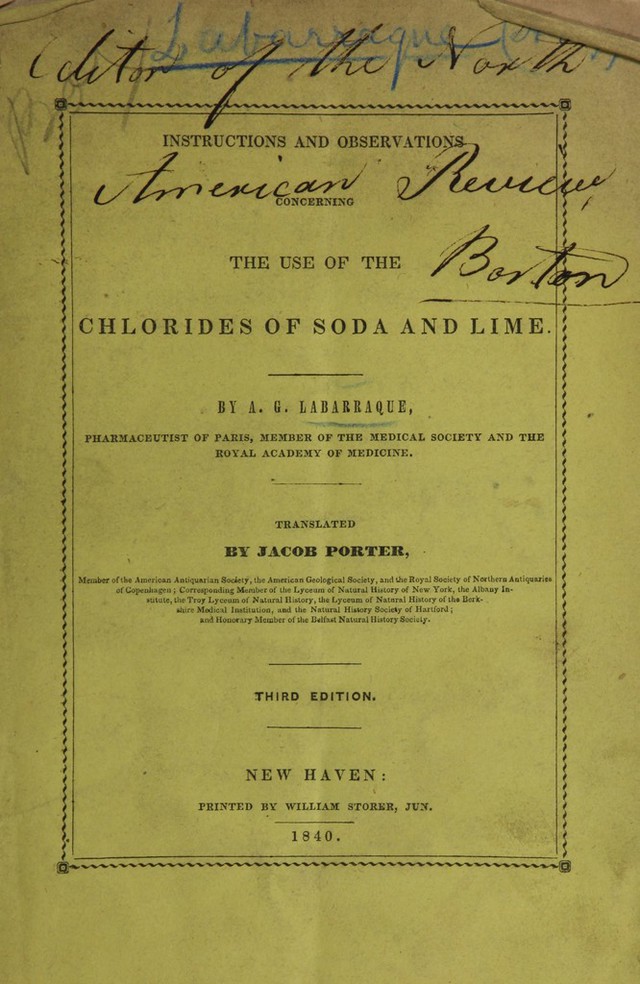
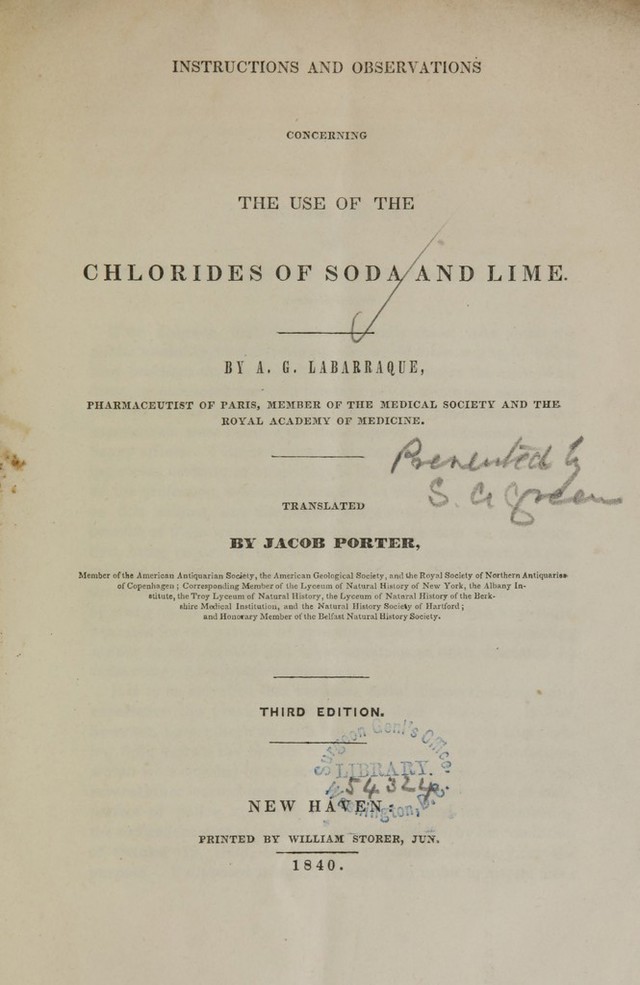
Instructions and observations concerning the use of the chlorides of soda and lime / by A.G. Labarraque ; translated by Jacob Porter.
- Labarraque, A. G. (Antoine Germain), 1777-1850. De l'emploi des chlorures d'oxide de sodium et de chaux. English
- Date:
- 1840
Licence: Public Domain Mark
Credit: Instructions and observations concerning the use of the chlorides of soda and lime / by A.G. Labarraque ; translated by Jacob Porter. Source: Wellcome Collection.
Provider: This material has been provided by the National Library of Medicine (U.S.), through the Medical Heritage Library. The original may be consulted at the National Library of Medicine (U.S.)
18/36
![lirium. M. Segalas was called. This physician, by the intro- duction of the catheter, confirmed the diagnostics pointed out by the symptoms. A catheter of elastic gum, introduced with the greatest facility, gave vent to a large quantity of purulent urine, and of an insupportable odor. The instrument was left in the urethra for two days, but was several times obstructed. Several times, in consequence of this, injections were used, but they had little success, which determined M. Segalas to make use of a ca- theter of a double course, and wash the bladder with a large quantity of water, following the ingenious method of M. Jules Cloquet. This expedient, employed several days in succession, had the effect, that was anticipated from it. The bladder was relieved from the influence of the putrid matters, that disturbed it, the urine flowed with facility by the tube, and the general state of the patient was sensibly ameliorated ; still the urine continued to deposit fetid purulent matter, which sometimes passed the catheter almost pure. M. Segalas then had recourse to the chloride of soda diluted in sixty parts of water, and conveyed into the bladder by means of the double catheter. A first irrigation of this kind produced a very remarkable diminution in the secretion and odor of the purulent matter; a second, made forty-eight hours afterwards, was followed with similar success, and two others, made at two days' interval, so far restored the patient, that he was able to attend to his occupation, making use regularly of the catheter for each excretion of urine. The patient experienced no painful sensation during the irri- gation made with the chloride thus diluted in water. This case was communicated to the Royal Academy of Medi- cine at the sitting of August 1], 1825. It is believed that certain poisons may be destroyed by the contact of the same chloride ; but the experiments have not yet been sufficiently numerous to affirm it with certainty. The linen and lint, that are used for dressing the fetid sores, preserve, for a long time, their odor, and contribute to the un- healthiness of the place where they are laid. This may be pre- vented by turning a cup of concentrated chloride upon five quarts](https://iiif.wellcomecollection.org/image/b21135289_0018.jp2/full/800%2C/0/default.jpg)